The energy secrets of jellyfish
Updated: 2013-10-20 08:02
By James Gorman(The New York Times)
|
|||||||


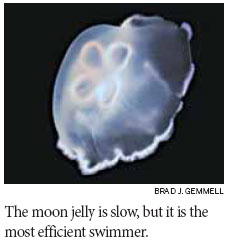
The moon jelly, or common jellyfish, is often viewed as an ecological invader, a nuisance to swimmers, or worse. A moon jelly population explosion last month clogged the water intakes of a Swedish nuclear power plant, forcing it to shut down. The jellyfish, which can be 5 to 38 centimeters in diameter, is such a concern that engineers in South Korea designed seagoing, prowling robotic blenders to liquefy them.
But some researchers were interested in another aspect of these highly successful blobs: They may be the most efficient swimmers on the planet.
Brad J. Gemmell at the Marine Biological Laboratory at Woods Hole in Massachusetts, and several other scientists, analyzed the movement of the jellies as part of a Navy-funded project to look at what Dr. Gemmell called "nontraditional propulsion."
The scientists used a new way of calculating energy called "cost of transport" that took account of what was happening throughout the two-phase swimming motion of the jellyfish. In the first phase, the jelly contracts its open bell and pushes water behind it, propelling itself forward. Then, the bell returns to its original shape and fills with water again.
Earlier studies had shown that the jelly got a second thrust during the rest and refill phase, but they had not calculated the jelly's energy expenditure during that time. It turned out the jelly was not actually doing any work in that phase. Instead the elastic tissue in the bell acted like a rubber band, re-forming the bell. That action produced water movement under the jelly, called a vortex, that pushed it forward.
The study found that the secondary push was responsible for about 30 percent of the distance traveled by the jellyfish. And it worked even with anesthetized jellies that were pushed through the water. The recovery phase and its kick were purely mechanical. "That's what makes them so energy-efficient," Dr. Gemmell said.
The finding offers some ideas about propulsion that could be useful to the Navy. This kind of low-energy, high efficiency thrust would not power any kind of fast-moving, quick-turning ocean craft, but it might be useful for monitoring devices that need to maintain a position or move at a slower pace.
It also could be one reason, Dr. Gemmell said, why the jelly has so much energy to spend on reproduction, producing those problematic population explosions.
The New York Times
(China Daily 10/20/2013 page11)