Stem cell implants overtake science
Updated: 2013-09-29 07:26
By Laura Beil(The New York Times)
|
|||||||


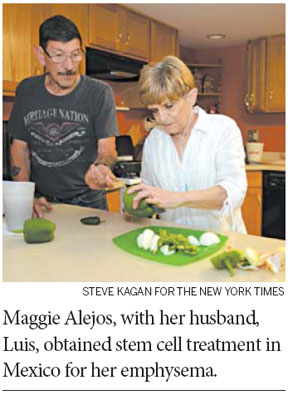
TIJUANA, Mexico - Maggie Alejos arrived here in June from St. Anne, Illinois, with a cashier's check for $13,500, payable to the Regenerative Medicine Institute.
Thin, with an oxygen tube anchored above her upper lip, Ms. Alejos, a retired Army nurse, has coped with emphysema for a dozen of her 65 years.
At a hospital here, doctors extracted about 200 grams of fat from her thighs, hoping to harvest about 130 million stem cells and implant them in her failing lungs.
Across the Internet - where Ms. Alejos learned about the Tijuana institute - adult stem cells are promoted as a cure for everything from sagging skin to severed spinal cords.
On the surface, the claim is plausible. Scientists have discovered that fat, bone marrow and other parts of the body contain stem cells, immature cells that can rejuvenate themselves.
But it has yet to be proved that these cells can regenerate no matter where they are placed, or under what conditions this might occur. Moreover, questions about safety remain.
But this has not slowed the rise of an international industry catering to customers who may pay tens of thousands of dollars for their shot at a personal miracle.
Dr. Hesham Sadek of the University of Texas Southwestern Medical Center in Dallas, who is studying heart muscle regeneration, worries that the marketing deluge now makes it hard for patients to tell science from swindle. "It really has the potential to undermine the legitimacy of the whole field," he said.
If too many patients try stem cells unsuccessfully, the public may come to see the entire field as a failure, he said.
The International Society for Stem Cell Research has released a statement declaring the use of stem cells outside scientific settings to be "a threat to patient welfare, patient autonomy and to the scientific process."
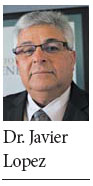
Tijuana has perhaps 20 clinics offering adult stem cell therapy. Dr. Javier Lopez, founder of the Regenerative Medicine Institute, was born and educated in Tijuana, though he has lived and worked across the border, in San Diego, California, for more than 30 years, mainly as a health care administrator.
He says he runs the institute within the accepted framework of clinical trials: Patients sign consent forms acknowledging that the treatment is experimental. Studies are registered with the National Library of Medicine in the United States.
Being accepted for treatment requires more than cash. Protocols and procedures are approved by the institutional review board, or I.R.B., at Hospital Angeles Tijuana, and are administered by physicians at the hospital. "The focus of our trial, from Day One, has been safety," Dr. Lopez said.
But Leigh Turner, a bioethicist at the University of Minnesota, says the Regenerative Medicine Institute blurs the boundary between trial and treatment. The institute's patient consent form "would not pass muster with a competent American I.R.B.," Dr. Turner said, and the testimonials on its Web site place the emphasis squarely on results.
Moreover, studying patients who pay undermines the trials' scientific validity, Dr. Turner said. The patient sample is skewed toward those with means, and their financial investment may amplify an already strong placebo effect.
Dr. Lopez says that scientists in Mexico lack the government research support available in the United States, leaving establishments like his no choice but to charge patients.
He agrees that many stem cell providers are dubious, and says he works with the Mexican authorities to try to establish uniform standards. As for his own institute, he said, "I'm very proud of what we are doing," and added, "I get upset when people start talking trash about what is done south of the border."
There is little evidence to indicate if adult stem cell treatments on offer are working. Paul Knoepfler, a stem cell researcher at the University of California, Davis, says the lack of data is vexing.
"We have a tremendous enthusiasm about the potential of stem cell therapy," said Dr. George Q. Daley, who studies stem cells for blood diseases at Harvard Medical School. "That said, these aren't magical agents that run around your body and fix things. It's frustrating to watch other people who, even well intentioned, aren't acting in their patients' best interest."
Back home in St. Anne a few days after the procedure, Ms. Alejos had a brief bout of pneumonia over the summer, but generally feels no better or worse than she did before her treatment. She knows she will not be cured. Her dreams are modest, like being untethered from oxygen long enough to go out to a movie.
"I was an Army nurse for 30 years," Ms. Alejos said. "I know there is no such thing as a miracle in the world of medicine."
The New York Times
(China Daily 09/29/2013 page11)