Privacy? Go to your room
Updated: 2013-09-08 07:38
By Tom Brady(The New York Times)
|
|||||||


With almost daily revelations about American government programs that spy on officials, both domestic and foreign, and the e-mail and cellphone communications of private citizens, it makes one stop and think twice before leaving the house.
The Japanese, who in many ways ignited the technological revolution with their efficient electronics companies, are steps ahead of the rest of the world once again.
As far back as 2006, The Times reported on Japanese teenagers who spent up to 23 hours a day in their room. For days, weeks, even years at a time. A steady diet of reports since has detailed the lengthy quarantine periods of these boys and men, some of whom have spent a decade or more indoors.
It is called Hikkomori. The literal translation is "pulling inward, being confined," and as the BBC reported in July, there are millions of Japanese - the average age of those withdrawing has risen to 32 from 21 in the last two decades - who have dropped out.
|
The latest face-recognition technology makes it harder to stay out of view. A group of Edward Snowden impersonators at a hearing in Brazil. Ueslei Marcelino / Reuters |
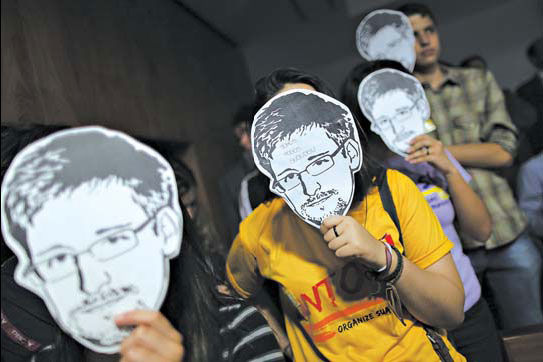
If these shut-ins were aware of the latest face recognition technology that agencies in the United States are working on, it all might make sense. The United States Department of Homeland Security has made progress on a computerized tool known as the Biometric Optical Surveillance System, Ginger McCall, a lawyer and privacy advocate, wrote in The Times.
These systems have benefits for law enforcement, Ms. McCall wrote, but are ripe for abuse. The technology, she said, makes it too easy for the authorities to identify and track people they believe to be threats, real or imagined, and allows officials "to track the movements of ex-lovers or rivals. 'Mission creep' often turns crime-fighting programs into instruments of abuse."
Ms. McCall recommends oversight of this technology "to protect civil liberties, in particular our expectation of some degree of anonymity in public."

That goal may sound ingenuous, particularly in an era when cameras are ubiquitous in urban areas around the world and when the personal activities and proclivities of many are a Facebook post or a Google search away.
Laura Poitras, a lesser-known player in the Edward Snowden case, uses encryption software to shield her online data and personal information. Ms. Poitras began investigating the American government's surveillance programs before Mr. Snowden came along, and has made documentary films on the Iraq war and a Yemeni prisoner at Guantanamo. Glenn Greenwald, the writer from The Guardian who broke Snowden's story, is almost as well known as his source, but it was Ms. Poitras who made contact with him and shot the video in Hong Kong when he came out as a whistleblower.
Her efforts to remain in the background have not helped her much, particularly when she travels. Since 2006, she has been detained more than 40 times in American airports.
"It's a total violation," she told The Times. "They are interested in information that pertains to the work I am doing that's clearly private and privileged. It's an intimidating situation when people with guns meet you when you get off an airplane."
She has never been given an explanation for why she is on a watch list.
"I've been told nothing, I've been asked nothing, and I've done nothing," Ms. Poitras said. "It's like Kafka. Nobody ever tells you what the accusation is."
For comments, write to nytweekly@nytimes.com.
The New York Times
(China Daily 09/08/2013 page9)