Please eat the exhibits
Updated: 2013-08-25 09:21
By Ye Jun(China Daily)
|
|||||||


|
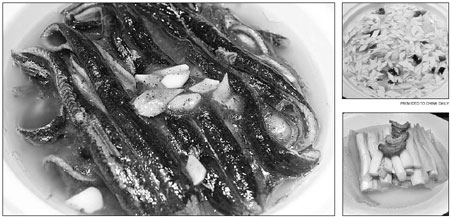
Left: Huai'an's traditional braised eel uses only the backs of those about the size of a chopstick, because they are the tastiest. Right: Pingqiao bean-curd soup and Kaiyang pucai. Photos by Ye Jun / China Daily Provided to China Daily |
Huai'an residents believe their foods are museum-caliber, and a proud chef has come to the capital to convince Beijingers, Ye Jun reports.
A cuisine style considered so important that locals created a museum for it has to be worth trying. Cai Guobin, a 37-year-old from Huai'an, Jiangsu province, is executive chef with China Huaiyang Cuisine Cultural Museum. He is working as a guest chef at a Huaiyang food event at the Red Chamber Chinese Restaurant, China World Summit Wing Beijing until Aug 25. "Huaiyang cuisine has several hundred years of history. The local government places a lot of importance on it. More than 10 gourmet festivals have been held," says Cai, who has worked for 21 years as a cook.
The museum, according to Cai, has 8,000 square meters for displays that include local wedding customs, the story of Huaiyang cuisine, and a history of the regional salt business.
The name Huaiyang comes from the initial characters of Huai'an and Yangzhou, but the concept of Huaiyang cuisine is already extended to include food styles of the nearby area. The cuisine immediately relates to Huai'an, Yangzhou and Zhenjiang, cities on the path of the Beijing-Hangzhou Grand Canal, a lifeline of transportation in ancient China. A flourishing salt business brought prosperity to the area, giving rising to beautiful gardens and a gourmet cuisine.
In modern times, Huai'an has been the hometown of some famous people, too. These include China's late premier, Zhou Enlai, and Wu Cheng'en, author of Journey to the West. Apart from the cultural displays, the museum has two kitchens serving classic and new dishes of Huaiyang style.
Cai, who runs both kitchens, says while Yangzhou food adopts ingredients from around the country, Huai'an cuisine uses a lot of local produce.
This is reflected in the Huai'an menu at Red Chamber. Many specialties are named after the area in Huai'an where the ingredients hail from.
Bean-curd soup is from Pingqiao. A local landlord is said to have served it almost three centuries ago to visiting Qing Emperor Qianlong - quite a gourmet himself, if we judge from the number of foods with stories relating to him. The emperor praised it, and the soup has been popular ever since.
Of course, the secret of any food's long-term popularity lies in good taste. Tofu for the Pingqiao-style soup has to be cut neatly into small rhombic shapes, and made with chicken stock.
Pucai, or cattail from Kaiyang, is also very special. It is the crisp and tender stem of a water plant, raised in very deep, fertile silt. Very tender and delicate, pucai is mostly sauteed and added to chicken soup, then topped with dried shrimp. The tenderness reminds one of white asparagus, only more tender. It's become a high-end delicacy locally.
Huai'an has many rivers and lakes, such as Hongze Lake, Dayun Lake, the ancient Yellow River, and Baima Lake. The city is a proud producer of good rice and fishes.
Silver minnow is lightly brined and dried to give it a bit of good chewy texture, before it's steamed and served. Huai'an's braised eel uses only the back of those about the size of a chopstick, because they offer the best taste.
The preparation of the eel is a good example of how much effort is made in the food style. The eel is boiled until the pot is seething, and then simmered for 15 minutes with an array of seasonings - ginger, shallot, yellow rice wine, salt and vinegar. Then the eel is taken out, and rinsed with water. Chefs will slice it open to take only the flesh on the back, frying it in salad oil with soy sauce, black pepper, yellow rice wine, starch and garlic slices.
Chef Cai says Huai'an food offers simple but good countryside taste, like that made by "an old mom". Compared with Cantonese food, which uses a lot of seasoning, Huai'an cuisine relies more on the taste of the ingredients themselves. Although the dishes look simple, the chef's effort is apparent in the food and its taste.
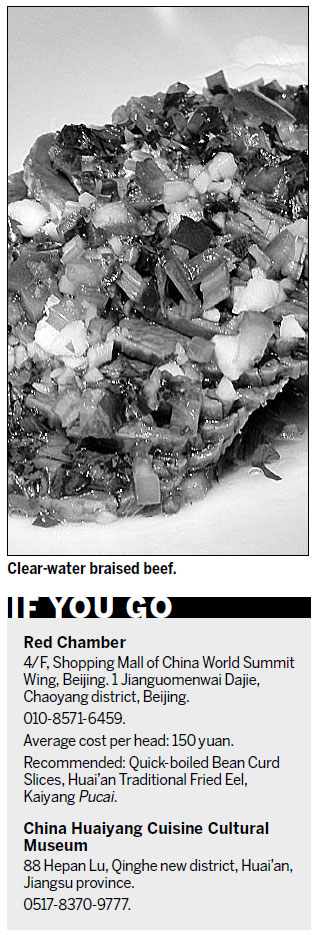
To adapt to modern tastes, Cai says local chefs have meshed modern concepts of health into Huai'an food. Local people, who once used pork fat in the cooking, now replace it with vegetable oil. "Clear water" beef is braised in vegetable juice during preparation to make it more tender and healthy.
Quick-boiled bean-curd slices, brined "oily chicken", and Qingong pork meatball processed with an iron pole are also classic Huai'an specialties.
The chef says he and his team have worked to present "the tastes we had in childhood". Although he depicts Huai'an cuisine as that made by a countryside grandma, the amount of effort put into the food, and its simple but natural taste, may explain why the food style has earned its place in a museum.
Contact the writer at yejun@chinadaily.com.cn.
(China Daily 08/25/2013 page13)