Tracing warming through past sea levels
Updated: 2013-08-25 09:20
By Justin Gillis(The New York Times)
|
|||||||


|
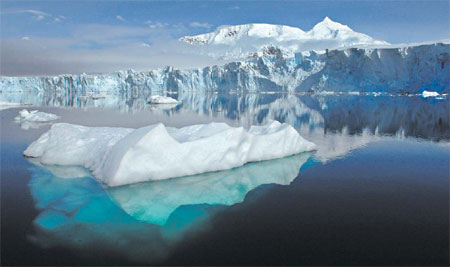
The collapse of the West Antarctic Ice Sheet could cause the oceans to rise at a rate of several meters in a few centuries, a team of scientists believes. NASA / British Antarctic Survey |
Thirty-five years ago, a scientist named John H. Mercer issued a warning. By then it was already becoming clear that human emissions would warm the earth, and Dr. Mercer had begun thinking about the consequences.
His paper, in the journal Nature, was titled "West Antarctic Ice Sheet and CO2 Greenhouse Effect: A Threat of Disaster." In it, Dr. Mercer pointed out the unusual topography of the ice sheet sitting over the western part of Antarctica. Much of it is below sea level, in a sort of bowl, and he said that a climatic warming could cause the whole thing to degrade rapidly on a geologic time scale, leading to a possible rise in sea level of about five meters.
While most scientists agree that the planet is in the early stages of what is likely to be a substantial rise in sea level, they still do not know if Dr. Mercer was right about a dangerous instability that could cause that rise to happen rapidly, in geologic time. Researchers may be getting closer to figuring that out.
A new paper comes from Michael J. O'Leary of Curtin University in Australia and five colleagues from around the world. Dr. O'Leary has spent more than a decade exploring the remote western coast of Australia, considered one of the best places in the world to study sea levels of the past.
The paper, published in Nature Geoscience, focuses on a warm period in the earth's history that preceded the most recent ice age. In that epoch, sometimes called the Eemian, the planetary temperature was similar to levels the world may see in coming decades as a result of human emissions, so it is considered a possible indicator of things to come.
Examining elevated fossil beaches and coral reefs along more than 1,600 kilometers of coast, Dr. O'Leary's group confirmed something scientists pretty much already knew. In the warmer world of the Eemian, sea level stabilized for several thousand years at three to four meters above modern sea level.
Dr. O'Leary's group found what they consider to be compelling evidence that near the end of the Eemian, sea level jumped by another five meters or so, to settle at close to nine meters above the modern level, before falling as the ice age set in.
Dr. O'Leary said in an interview that he was confident the five-meter jump happened in less than a thousand years - how much less, he cannot be sure.
This finding is something of a vindication for one member of the team, a North Carolina field geologist, Paul J. Hearty. He had argued for decades that the rock record suggested a jump of this sort, but it was only recently that measurement and modeling techniques reached the level of precision needed to be certain.
If the work does hold up, the implications are profound. The only explanation for such a large, rapid jump in sea level is the collapse of a polar ice sheet, on either Greenland or Antarctica.
Dr. O'Leary is not prepared to say which; figuring that out is the group's next project. But a five-meter rise in less than a thousand years, a geologic instant, has to mean that one or both ice sheets contain some instability that can be set off by a warmer climate.
Another paper, by Anders Levermann of the Potsdam Institute for Climate Impact Research in Germany, implies that even if emissions were to stop tomorrow, the world has probably locked in several meters of sea level rise over the long term.
Benjamin Strauss and his colleagues at Climate Central, an independent group of scientists and journalists in Princeton, New Jersey, calculated that by 2100, continuing on our current path would mean a long-term sea level rise of seven meters, but aggressive emission cuts could limit that to two meters.
On that crucial point science has not ascertained the answer. Scientists can look at the rocks and see indisputable evidence of jumps in sea level, and they can associate those with relatively modest increases in global temperature.
But the nature of the evidence is such that it is hard to tell the difference between something that happened in a thousand years and something that happened in a hundred.
On the human time scale, of course, that is all the difference in the world.
If sea level is going to rise by 17 meters over a thousand years, that is quite a lot of time to adjust - to pull back from the beaches, to reinforce major cities, and to develop technologies to help us cope.
The New York Times
(China Daily 08/25/2013 page11)