Link between autism and a cancer gene
Updated: 2013-08-25 09:20
By Gina Kolata(The New York Times)
|
|||||||


|
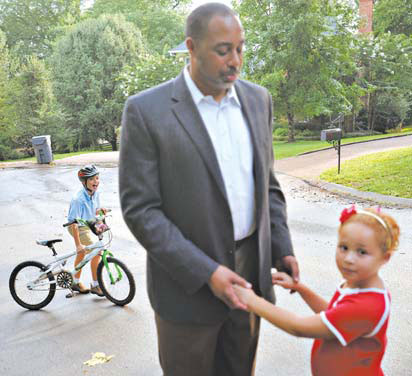
Richard Ewing, 10, shown with his father and sister, is autistic and has a tumor-causing genetic mutation. Christopher Berkey for The New York Times |
Researchers studying two seemingly unrelated conditions - autism and cancer - have unexpectedly converged on a surprising discovery. Some people with autism have mutated cancer or tumor genes that apparently caused their brain disorder.
Ten percent of children with mutations in a gene called PTEN, which cause cancers of the breast, colon, thyroid and other organs, have autism. So do about half of children with gene mutations that can lead to some kinds of brain and kidney cancer and large tumors in several organs. That is many times the rate of autism in the general population.
Dr. Evan Eichler, a professor of genome science at the University of Washington, and others caution that the findings apply to only a small proportion of people with autism; in most cases, the cause remains a mystery. And not everyone with the mutations develops autism or cancer, or other disorders associated with the genes. But researchers say the findings are intriguing, given that they have no way of analyzing what might cause autism and no cure. The discovery has enabled scientists to genetically engineer mice with many symptoms of the human disorder.
And it has led to the first clinical trial of a treatment for children with autism, using the drug that treats tumors that share the same genetic basis.
Richard Ewing of Nashville, Tennessee, a 10-year-old who has a form of autism caused by a tumor-causing gene, is part of the new study. His parents, Alexandra and Rick Ewing, know he is at risk for tumors in the brain, heart, kidney, skin and eyes. But that bad news was tempered by his eligibility for the clinical trial, which just started. "There is a big difference between us and the rest of the autism community," Mr. Ewing said. "We have an honest-to-God genetic diagnosis."
Not everyone agrees that the discovery is so promising. Steven McCarroll, a geneticist at Harvard University, notes that autistic children with the cancer gene mutation have "a brain that is failing in many ways." Autism in these children could be a manifestation of a general brain malfunction, he said, adding, "The fact that autism is one of the many neurological problems that arise in these patients doesn't necessarily tell us anything penetrating about the social and language deficits that are specific to autism."
But other scientists say the work is changing their understanding of autism. Like cancer, autism can involve unregulated growth of cells, in this case neurons in the brain.
Dr. Charis Eng, a cancer geneticist at the Cleveland Clinic in Ohio, first noticed a surprising incidence of autism in children whose parents had the PTEN mutation. Investigators found that the rate of autism was about 10 times what would normally be expected.
At the same time, researchers found that another genetic disorder was even more likely to result in autism. That disorder, tuberous sclerosis, increases the risk for kidney cancer and a type of brain cancer; half of tuberous sclerosis patients had autism.
The genes are part of a network of genes that puts a brake on cell growth. Disabling the genes releases that brake. One result can be cancer or tumors. Another can be abnormal wiring of nerve fibers in the brain and autism.
Dr. Mustafa Sahin of Boston Children's Hospital is testing whether drugs used to treat tumors caused by tuberous sclerosis gene mutations might treat autism in people with the mutation.
He started with mice, deleting tuberous sclerosis genes in their cerebellums. Nerve fibers in the animals' brains grew wildly, and the mice had unusual behaviors, reminiscent of autism. But Rapamycin, which targets the tuberous sclerosis gene and blocks a protein involved in cell division, changed the animals' behavior.
Now Dr. Sahin is giving a similar drug, everolimus, to autistic children with a tuberous sclerosis gene mutation. Richard is part of that study.
Dr. Eichler focused on autism that occurs with no family history, recruiting 209 families with autistic children. He saw a striking difference. Compared with their parents and siblings, the autistic children had two to three times as many mutations that disabled a gene. Those genes were often part of a pathway that controls cells growth. Researchers initially thought the pathway's link to autism was murky. "Then I said: 'Wait, some of those genes are cancer genes,' " Dr. Eichler said.
For Andrew and Lucy Dabinett's son, Tommy, 9, whose autism is caused by a PTEN gene mutation, there are no clinical trials yet.
Tommy has a limited vocabulary, flaps his arms, rocks back and forth, and needs diapers.
"I already knew there was something terribly wrong with my child," Ms. Dabinett said.
"Honestly," she said, "it was a relief to have an answer."
The New York Times
(China Daily 08/25/2013 page11)