Tools that answer before you ask
Updated: 2013-08-18 07:50
By Claire Cain Miller(The New York Times)
|
|||||||


SAN FRANCISCO - In Hollywood, there are umbrella holders. Outside corner offices, there are people who know exactly how much cream to pour in the boss's coffee. In British castles, members of royal families have their valets.
And then there is Silicon Valley, where mind-reading personal assistants come as cellphone apps.
A range of start-ups and big companies like Google are working on what is known as predictive search - new tools that anticipate what you need before you ask for it. Glance at your phone in the morning and an application has read your e-mail, scanned your calendar, tracked your location, parsed traffic patterns and figured out you need an extra half-hour to drive to the meeting.
The technology is the latest development in Web search, and one of the first tailored to mobile devices. Your context alone - location, time of day and digital activity - is the query, say the engineers who build these services.
Many technologists agree that these services will probably become mainstream, eventually incorporated in alarm clocks, refrigerators and mirrors. Already, an app called Google Now is an important part of Google's Internet-connected glasses.
Google Now is "kind of blowing my mind right now," said Danny Sullivan, a founding editor of Search Engine Land. "I mean, I'm pretty jaded, right? I've seen all types of things that were supposed to revolutionize search, but pretty much they haven't. Google Now is doing that."
But for some people, predictive search is the latest intrusion into our lives that straddles the line between helpful and creepy.
"To the question of creepiness, the answer is it depends who you ask," said Andrea M. Matwyshyn, an assistant professor at the Wharton School of the University of Pennsylvania, who studies the legal implications of technology. "What works for a group of 30-something engineers in Silicon Valley may not be representative of the way that 60-year-old executives in New York tend to use their phones."
The technology is emerging because people are desperate to deal with the inundation of digital information, and because much of it is stored in the cloud where apps can easily access it.
The services guess what you want to know based on the digital trail you leave, like calendar entries, e-mails, social network activity and the places you take your phone. Many use outside services for things like coupons, news and traffic.
Google Now, which came to some Android phones a year ago and to iPhones in April, tells you when it is time to leave for a dinner reservation. That is because it noticed an OpenTable reservation e-mail in your Gmail in-box, noted your location from your phone's GPS and checked Google Maps for traffic conditions.
Predictive search, though, is as complicated as real life. If you are in London on business, which an app would know from the events on your calendar, you probably want a PDF related to work. But if you are there on vacation, you might want directions to Big Ben.
Many of the apps use machine learning to get to know people.
ReQall's service can block calls from interrupting meetings. But one day, the son of reQall's co-founder, Sunil Vemuri, was sick at home with Mr. Vemuri's father, who was trying to reach him with a medication question. Because he called more than once, and reQall knew the two had the same last name and spoke often, the app interrupted Mr. Vemuri's meeting.
The goal is to move beyond logistical help to sending you anything you might need to know. Google in May added book, movie and music recommendations.
Ads are not far off. "The better we can provide information, even without you asking for it, the better we can provide commercial information people are excited to be promoting to you," Larry Page, Google's chief executive, told analysts in April.
Some skeptics say pushing ads and other unwanted information could be a violation of privacy. If you watch a movie trailer on YouTube, for instance, Google Now may send local showtimes when the film arrives in your city. But what if you hated the trailer?
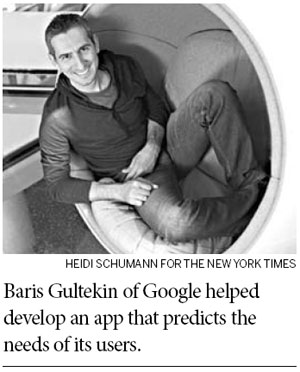
Baris Gultekin, a product management director at Google who helped invent Now, said the company was aware of the risk of disruption and was "very conservative" with what it showed people.
Daniel Gross, co-founder of the personal assistant app Cue, said that was why it had started with alerts in which a person had already shown interest, by creating a calendar entry, for example.
"It's a really tricky problem, because on one hand you really want to give someone the best experience you possibly can. And on the other hand," he said, you don't want someone to think, "'Oh my gosh, this feels too good.'"
The New York Times
(China Daily 08/18/2013 page10)