A building powered by algae growth
Updated: 2013-06-16 07:42
By David Wallis(The New York Times)
|
|||||||


|
Advocates of algal biofuel must first control its cost. The design firm HOK said producing energy with bioreactors would cost seven times more than with solar energy. The Bio Intelligent Quotient building in Hamburg, Germany. Colt international, arup deutschland, ssc |
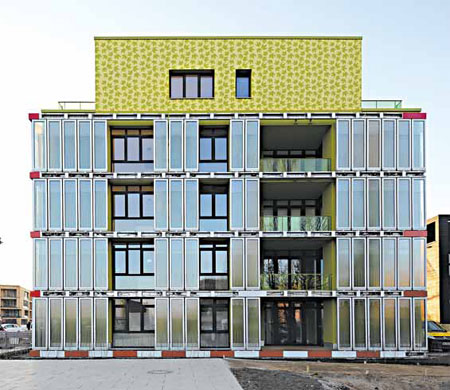
A new apartment complex in Hamburg, Germany, looks like a modern structure and has some of the latest technology in sustainable building - a vertical algae farm.
The designers of the $6.58 million Bio Intelligent Quotient (B.I.Q.) building, which relies entirely on renewable energy, promise that their pioneering energy system will harvest fast-growing algae to create biofuel, produce heat, shade the building, abate street noise and make history.
Mounted on the southwest and southeast sides of the building are 129 bioreactors, flat glass panels on exterior louvers that serve as an environment for the algae to flourish. The system was built by a consortium that included the global architectural firm Colt Group.
In 2009, the consortium won a competition that asked entrants to use smart materials, defined as "systems and products that behave dynamically, unlike conventional building materials, which are static."
The algae are fed liquid nutrients and carbon dioxide to spur growth in the system that became operational in April. Pressurized air is pumped into the panels to further increase growth and prevent the micro-organisms from settling down and causing rot, said Jan Wurm, one of the designers. He notes that scrubbers in the panels automatically keep the glass clean. The panels double as solar thermal collectors to convert sunlight into usable energy.
"The part of the light which is not absorbed by the algae for the photosynthesis is converted into heat," said Mr. Wurm, and can be used immediately for hot water or stored in the building's underground geothermal system.
Periodically, the algae will be collected and stockpiled in tanks in the building. A local energy company then will buy the harvest and transport the biomass to a nearby heat and power plant, where it will be fermented. The process produces methane gas to generate electricity. "The generated power would be carbon-neutral," Mr. Wurm said.
The designers of the B.I.Q. house did not sacrifice form for function. The chlorophyll green color from the algae, combined with the bubble ballet from rising pressurized air, looks a little bit like a lava lamp, Mr. Wurm said.
Whether a building with algae bioreactors is the start of something big or amounts to a one-of-a-kind experiment generates plenty of debate. Mr. Wurm acknowledges that the nascent technology costs more than solar or conventional fuel systems. "In terms of investment costs you can't compare it to established, mass produced systems on the market," he said.
Jonathan B. Wimpenny of the Royal Institute of British Architects USA questions whether many banks and developers will invest in algae bioreactors. "I can hardly deem this as a watershed moment in everyday building practice," Mr. Wimpenny said.
But to David J. Bayless of Ohio University, the Hamburg building is an important test case. "People are leery of algae because it's a relatively unknown technology," he said.
Scott Walzak, a designer at HOK, acknowledges that several impediments stand in the way of realizing the bold plan. Barriers include preventing contamination from algae-eating bacteria, finding the ideal strain of algae to grow fast enough and maximizing the extraction of lipids from the biomass.
"Algae goes through the photosynthesis stage, you get lipids, which is basically a form of oil, and you have to subtract that out of the algae itself," he said. "You can think of it as pressing oil out of an olive."
Cost is also a potential obstacle. Mr. Walzak estimates that the cost per kilowatt-hour produced by algae bioreactors would be seven times that of solar power and 14 times that of crude oil.
Anica Landreneau, a consulting leader at HOK, envisioned tapping car exhausts from the Santa Ana Freeway in California as a carbon source to feed algae. "It thrives on a junk-food diet," said Ms. Landreneau.
Grow Energy, a start-up based in San Diego, California, is banking on just that for products that take different paths to generating energy from algae. The year-old company plans to produce two different algae bioreactors.
Next year, Grow Energy expects to accept pre-orders for its Verde system, which can be mounted on roofs, cultivates algae, automatically dries it and burns it in an on-site combustion generator to create electricity. The Verde system will cost about $12,000 and will produce roughly 35 percent of the electricity used by the average American home.
Like many proponents of sustainable energy, Tom Wiscombe, an architect, is encouraged by the Hamburg building.
"In the history of architecture, trying to keep organisms and fungus and mold constantly out" of a building was paramount, he said. "Now, we're actually trying to put it back in."
The New York Times
(China Daily 06/16/2013 page11)