Spring rite
Updated: 2013-05-05 07:38
By Wang Kaihao(China Daily)
|
|||||||


|
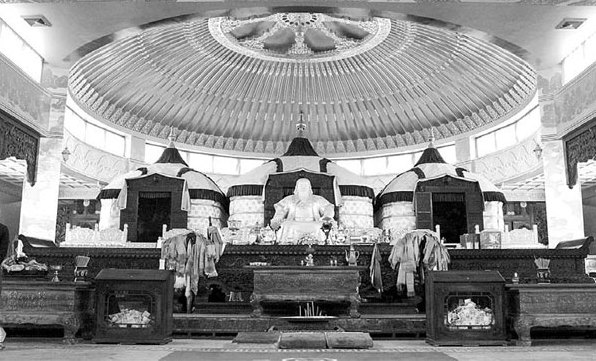
The majestic golden statue of Genghis Khan sits inside the palace of the mausoleum. Photos by Wang Kaihao / China Daily |
The Mausoleum of Genghis Khan turned into a ritual sanctuary recently as pilgrims celebrated the spring sacrifice. Wang Kaihao shares his experience in Ordos, Inner Mongolia.
Visitors to Inner Mongolia autonomous region will probably not understand the spirit of Mongolian ethnic group without seeing the Mausoleum of Genghis Khan in Ejin Horo Banner, Ordos.
I visited the mausoleum - considered one of the most sacred places in Mongolian culture - at the best time, coinciding with the annual spring sacrifice to honor the founder of Mongol Empire during the 13th century.
The event, which lasted from April 26 until May 3, attracted Mongolian people from all over the country and even overseas to gather at the site to pay homage.
I arrived at the mausoleum on April 29, the eve of the 21st day of the third month in Chinese lunar calendar. It's the most eventful day of the weeklong spring sacrifice. This day is called Tsagaansurek, which means "a white herd" in Mongolian.
Spring sacrifice is the biggest of the seasonal sacrifice. There are also 60 other special rituals throughout the year, including a grand ceremony during New Year.
I woke up before 7 am and made my way to the palace together with more than 70,000 pilgrims. Shortly after I left my lodge, I was caught in a massive traffic jam. But no one honked.
Although where Genghis Khan was secretly buried remains a major historical mystery in Mongols' history, this place which exhibits some of his belongings and portraits remains the utmost place in the heart of Mongolians since his death in 1227.
I followed the crowd to the main palace of the mausoleum shaped like three typical Mongolian yurts. Today's palace was built in 1956 on the original spot, after it was moved westward in 1939.
In the backroom of the middle palace, hundreds of pilgrims simultaneously knelt down, raised hands holding blue khatag - a long piece of silk used for blessings - and placed their tribute in front of a golden statue of Genghis Khan.
People leading the rituals are called Darhad, descendents of Genghis Khan's guards. In memory of Khan, an oil lamp has been burning uninterrupted for nearly 800 years under the meticulous protection of this group of people donned in special costumes and appeared to be very mysterious.
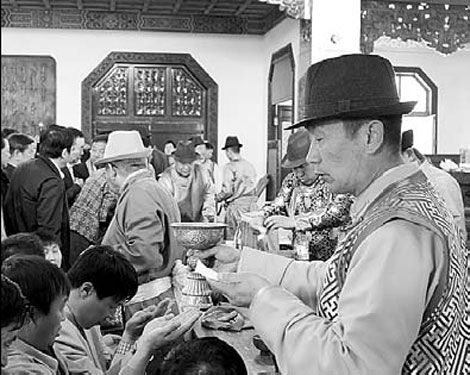
A public sacrifice ceremony began at 9 am. Eighty-one Darhad people sang the odes to honor their Emperor Lord.
Ushers wearing traditional Mongol warrior's arming wear led representatives from all nine districts and banners in Ordos, brought roast lamb and spirit (liquor) to present to the main building. A Darhad people's band blew conches and beat gongs, which made the atmosphere very solemn.
After that, the crowd circled clockwise around a shamanistic cairn called Gandeer Oboo to spread milk to honor the heaven, which is the climax of the ceremony. An old man sprinkled milk tea among the crowd to bless the pilgrims. It is said this tradition dated back to the time when Genghis Khan was alive.
I was really flattered when he walked toward me and dripped some liquid on my head.
The pilgrims also bowed in front of a white sacred horse to make wishes.
After a quick lunch, I went back to the mausoleum to witness another big sacrifice in the palace, which was supposed to begin at 3 pm.
I regretted not catching the detailed process of splendid and complicated rituals. By the time I was there, two men were singing a long paragraph of ballad using an unidentified ancient language, which is commonly called "the song of heaven".
People became a little restless when it was time to offer sacrifice. Everyone wanted to be the first to step into the palace, but the anxiety didn't last long. Within seconds, order returned like there were some unseen power which managed to calm them down.
When the ritual ended at 4:30 pm, all Darhad priests immediately returned to the palace and closed the door, leaving a strong mystic aura.
Contact the writer at wangkaihao@chinadaily.com.cn.
|
A Darhad people hosts the sacrifice offering ceremony in the palace. |
(China Daily 05/05/2013 page15)