Ally of Borges gains notice
Updated: 2013-05-05 07:37
By Larry Rohter(The New York Times)
|
|||||||


|
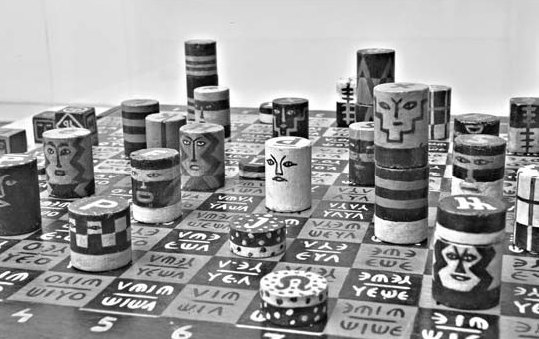
Xul Solar's "pan-chess" board, on view in New York, allowed for the creation of words in a language he devised. Philip Greenberg for The New York Times |
Jorge Luis Borges was destined to become one of the most influential literary figures of the 20th century, but only now is his closest ally, the eccentric painter Oscar Schulz Solari, starting to get the recognition that Borges always advocated for him.
Significantly, it is Solari, whose professional name was Xul Solar, who gets top billing in "Xul Solar and Jorge Luis Borges: The Art of Friendship," an exhibition at the Americas Society in New York. The show focuses on Xul Solar's watercolors, but includes manuscripts by both men, documents, photographs and first editions of works they created together that are little known outside their native Argentina.
"Borges never stopped expressing his admiration for Xul Solar, who he considered a citizen of the cosmos," Gabriela Rangel, the show's main curator, said. "This was an intellectual dialogue of two people that was profound and far-reaching, but has not yet been fully appreciated."
Borges and Xul Solar, who was also a poet, translator, inventor and astrologer, met in 1924, shortly after both had returned to Buenos Aires from long stays in Europe. They became collaborators, with Xul Solar providing illustrations for books that Borges wrote and magazines he edited, a symbiotic relationship that would continue until Xul Solar's death in 1963, at 75.
Borges was a dozen years younger than Xul Solar, and clearly looked up to his older friend. "Xul Solar is one of the most singular events of our era," he once wrote in an essay that is excerpted in the catalog for the Americas Society exhibition, "a man versed in all the disciplines, curious about all arcana, father of writings, languages, utopias, mythologies, sojourner in hells and heavens."
In the same essay, written for a show of Xul Solar's work in Buenos Aires in 1949, Borges characterizes his paintings as "documents of the extraterrestrial world." That description helps to explain the intellectual affinities and strikingly similar worldview the men shared, which is a point of emphasis for this exhibition.
"For both, the relationship between reality and dream was porous, and the material world and written text flowed into one another," a wall label notes. "They rejected realism in any form: Borges in his fiction, painstakingly creating hermetic fantastic worlds, and Solar in the execution of his metaphysical paintings that strived to look beyond the quotidian and see into a truer reality."
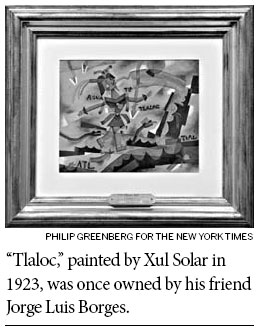
Several paintings in the exhibition, which will continue to July 20 then go to the Phoenix Art Museum in Arizona, evoke alternate universes or draw on letters, flags or arcane symbols. Ms. Rangel said that Borges for a time owned one of those watercolors, "Tlaloc," which employs Aztec-inspired images and word fragments.
Other works incorporate words from two languages Xul Solar invented, "Neo-Criollo" and "Pan-Lengua." There is even a "pan-chess" board that Xul Solar devised, in which the pieces represent letters and symbols and the squares syllables; together they create new words in the invented tongues.
The exhibition also shows some of Xul Solar's correspondence with and notes from a meeting with Aleister Crowley, the English occultist who introduced him to the I Ching. That became an important motif in the painter's later works, like the dark and foreboding "Desarrollo del Yi Ching."
The extent to which the painter influenced Borges's writings is hard to determine, Ms. Rangel said. But as the exhibition notes, Xul Solar appears as a character in one of Borges's most complex and influential stories, "Tlon, Uqbar, Orbis Tertius," which applies some of the painter's esoteric theories.
Like Borges, Xul Solar does not fit into the conventional narratives of artistic creativity in the 20th century and seems self-contained. Ms. Rangel suggests that is why the painter has until recently been overlooked. She said: "He is a real mystic, and that's an aspect of the avant-garde that historians don't want to have to acknowledge."
The New York Times
(China Daily 05/05/2013 page12)