A guide to the genome, from humanity's DNA
Updated: 2013-04-28 05:46
By Gina Kolata(The New York Times)
|
|||||||


Eight years of work, thousands of researchers around the world, $1 billion spent - and finally it was done. On April 14, 2003, scientists announced that they had completed the Human Genome Project, compiling a list of the three billion letters of genetic code that make up what they considered to be a sort of everyperson's DNA.
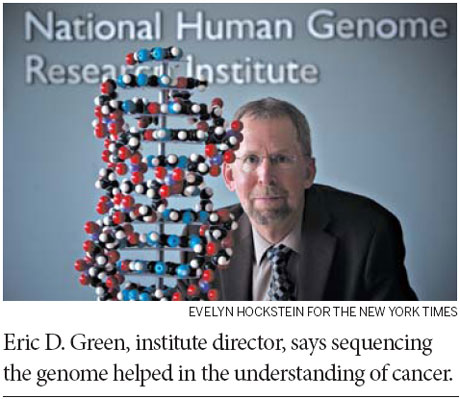
Eric D. Green, the director of the National Human Genome Research Institute at the National Institutes of Health, spoke about what has been accomplished, what it means and what is coming next.
Q. Take us back to that day 10 years ago. Whose genome was sequenced? And why would anyone want to know the genome sequence of some random person? Aren't we all unique?
A. The idea all along was not to sequence a person's genome, but to develop a resource. It would be the sequence of a hypothetical genome, a reference genome. It was meant to represent humanity.
Q. But if that hypothetical genome was made up of bits and pieces of DNA sequences from lots of different people, what good was it?
A. It was a reference that could be used for further research. People differ in only one out of 1,000 bases, so that reference genome is 99.9 percent identical to any person's genome. We used that tool to build sort of a highway map. We could go through it and add information about what was important.
The best analogy is to GPS in a car. It is nice to have a highway map, but you really want to know where is the gas station, the next park, a restaurant. We want to know where are the genes, the parts of the genome that code for proteins. Where are the places on the genome that people tend to vary? Where are the genes that code for diseases?
Q. How hard is it today to sequence a person's genome?
A. We can sequence a human genome in a couple of days for well under $10,000, probably around $4,000 or $5,000. And we sequence the genome you got from your father and the one you got from your mother. That's a total of six billion bases.
It is already around the cost of an M.R.I., and it will get cheaper yet.
Q. What about the naysayers who asked, "Where are the cures for diseases that we were promised?"
A. I don't hear that as much anymore. I think what's happening is just the sheer aggregate number of the success stories.
We are understanding cancer and rare genetic diseases. There are incredible stories now where we are able to draw blood from a pregnant woman and analyze the DNA of her unborn child.
Increasingly, we have more informed ways of prescribing medicine because we first do a genetic test.
We can use microbial DNA to trace disease outbreaks in a matter of hours.
These are just game changers. It's a wide field of accomplishment, and there is a logical story to be told.
The New York Times
(China Daily 04/28/2013 page11)