The village is alive
Updated: 2013-04-14 08:09
By Ju Chuanjiang and Wang Qian(China Daily)
|
|||||||


|
The mountainous village Zhujiayu is renowned for the preservation of its historical buildings dating to the Ming and Qing dynasties. Photos by Ju Chuanjiang / China Daily |
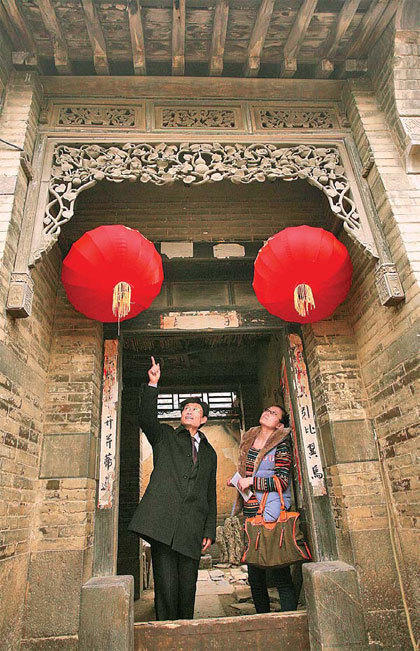
Surrounded by mountains, Zhujiayu is a rustic holiday destination with buildings dating back to the Ming and Qing dynasties. Ju Chuanjiang and Wang Qian visit the village and are charmed by the unpolished gem.
Zhujiayu, a 600-year-old mountainous village in Zhangqiu, Shandong province, is a good place for some tranquility and to get in touch with nature. Lying in a valley surrounded by green mountains, Zhujiayu was rated as one of the 24 Famous Chinese Historical and Cultural Villages in 2005 by the Ministry of Housing and Urban-Rural Development and the State Administration of Cultural Heritage. The village is about one-hour drive from capital Jinan. With a population of only 2,000 even in its prime time, the isolated rural village is renowned for the preservation of its historical buildings dating to the Ming and Qing dynasties (1368-1911).
Zhujiayu is divided into old and new village, which is encircled by a huge ancient wall built with vast rocks.
As we enter into the old village through an arched doorway, numerous traditional buildings greet us against the pleasant scenery of the background mountains. Walking through the thoroughfare feels as though we are back in ancient times.
Because of the local geology, the buildings in the old village are mostly built from stones and rocks from its nearby mountains.
There are about 300 residential houses, temples, pavilions, bridges and courtyards from the Ming and Qing dynasties perched on mountainside, surrounded by endless forests, fields coated with blooming flowers.
Most buildings are only one or two stories high. Although some of houses look shabby and the paint has faded, visitors can still feel the village's former glory from the exquisite carvings on the windows and roofs.
Rivers and creeks flow down from the surrounding mountains, winding through the whole village. Owing to this, more than 90 quaint stone bridges have been built during the past centuries, each with different design and style.
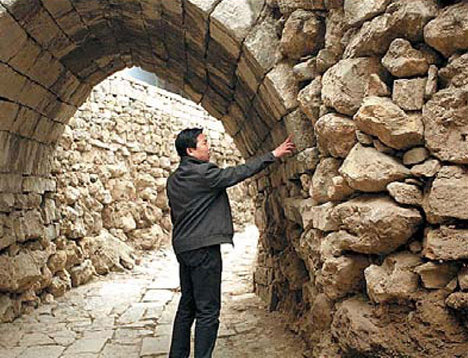
Among them, the well-preserved Zhaojia Bridge dating back to the Qing Dynasty (1644-1911) stands out. The single-arched bridge is about 5 meters high and is completely made of natural stones. It is composed of two levels of roads, one on top of the other.
Two temples in the village catch our attention. They are said to be built in the late Qing Dynasty. One house the statue of Wenchang and the other, statue of Kuixing - both considered the gods of literature in Chinese mythology. The two temples are special because most temples in rural areas are places of worship for the god of wealth, or Guanyin, the goddess of mercy.
"Education has long been valued in Zhujiayu, judging from the number of sishu or old-style private institution in the village. There used to be as many as 17 sishu, and the first female-only school in Shandong province," explains Zhai Bocheng, secretary-general of Zhangqiu Cultural and History Research Institute.
One of the sishu of the Qing Dynasty is still there in the village. The main building comprising a bedroom, a study room and a kitchen, remain in good condition, but a two-story hall which used to store books looks dilapidated.
The tutor, Zhu Fengyin, was rated as Jinshi, a successful candidate at an imperial examination during the reign of the Qing emperor of Guangxu. A tablet inscribed by the emperor to praise his talents is still hung on the wall.
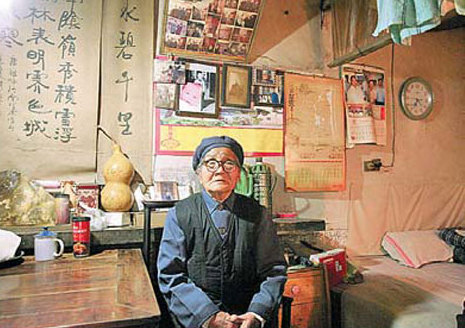
Zhu's 94-year-old granddaughter-in-law, Ma Yuying, still lives in the simple house. Her sons have tried persuading her to live with them in the city center, but she is not keen.
"I love the village and can't leave here. The air is good and the spring water tastes sweet. Every time my children come to see me, they will always bring several empty barrels to collect water to bring home," Ma says with a smile.
Like Ma, many of the elderly in the village lead a traditional lifestyle. They grow peanut and Chinese walnut on the mountains, process grains with stone mill, and cook with spring water.
But most young and middle-aged people have moved to the big cities, leaving their houses empty.
"There are now only 200 people living in the old village and most of them are over the age of 70," says Zhao Zhongwen, director of Zhujiayu Village Office.
As we wander around the village, we witness many worn-out and neglected houses with cracked walls.
Even so, when a private company offered to develop the village and build villas here several years ago, the local government rejected the proposal.
"Many historic villages have given way to modernization, but Zhujiayu, with its labyrinth of narrow streets and ancient buildings, still conjures up an image of ancient China," says Zhao with pride.
"We don't want to lose our original identity, which is also the most valuable thing to have," he says.
Its natural and traditional ambience has already brought fame to Zhujiayu. The village has become a popular spot where more than 20 films and TV drama have been shot since 2008.
"Streams of tourists now file past the ancient residential houses every weekend. The village receives more than 20,000 visitors from all over the country annually," says Zhao.
To further promote cultural tourism, the local government is planning to invest 80 million yuan ($12.9 million) to protect the village in the long run. Last year alone, a total of 30 million yuan has been allocated to repair houses and historic sites, and build basic facilities.
A museum of antique architectural style is under construction, to showcase the history, culture and anecdotes of the village.
If you go
Zhujiayu Village is located in the county-level city of Zhangqiu, about 45 km to the east of Jinan, capital of Shandong province.
High-speed trains to Jinan from Beijing and Shanghai run every couple of hours. It can be reached from Beijing in a little over two hours and from Shanghai in 3.5 hours. From Jinan downtown, take bus line K301 or a taxi.
Driving from Jinan and Zibo of Shandong province along national highway 309 to the village will take about one hour.
Entrance ticket to the old village is 20 yuan ($3.20). The opening time is from 8 am to 6 pm.
You'd better set aside about four hours for your trip and it's more fun to have lunch in family restaurants run by local farmers.
The best time to visit is from April to October when the leaves change color and springs gush out from mountains.
Contact the writers at juchuanjiang@chinadaily.com.cn and wangqian2@chinadaily.com.cn.
|
The 94-year-old Ma Yuying lives in the simple house and prefers village life. |
|
The Qing Dynasty single-arched stone-made bridge is composed of two levels of roads, one on top of the other. |
|
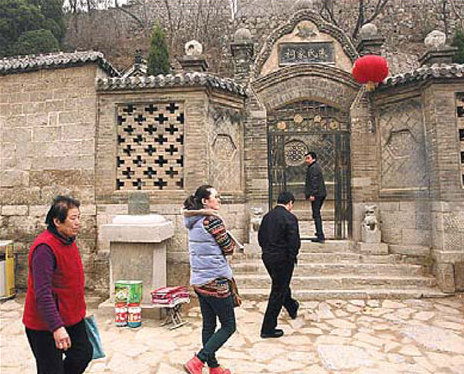
The Zhu Family ancestral hall built in the Qing Dynasty remains in good condition. |
(China Daily 04/14/2013 page16)