Online test-takers watched remotely
Updated: 2013-04-14 08:07
By Anne Eisenberg(The New York Times)
|
|||||||


|
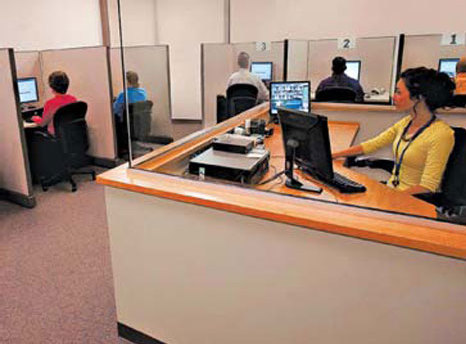
New eavesdropping technologies can track every mouse click and keystroke of students taking tests for online courses. Pearson Vue |
Millions of students worldwide have signed up in the last year for MOOCs, short for massive open online courses - those free, Web-based classes taught by professors at universities such as Harvard and Duke and the Massachusetts Institute of Technology.
But when those students take the final exam, how will their professors know that the test-takers on their distant laptops are doing their own work, and not asking Google for help?
The issue of online cheating concerns many educators, particularly as more students take MOOCs for college credit. Already, five classes from Coursera, a major MOOC provider, offer the possibility of credit, and many more are expected.
One option is for students to travel to regional testing centers at exam time. But reaching such centers is difficult for many students, whether working adults or others in far-flung places.
But now technologies can remotely track every mouse click and keystroke of test-taking students. Squads of humans at computers can monitor faraway students via webcams, screen sharing and high-speed Internet connections, checking out their photo IDs, signatures and even their typing styles to be sure the test-taker is the student who registered for the class.
The technology for remote proctoring may end up being as good as - or even better than - the live proctoring at bricks-and-mortar universities, said Douglas H. Fisher, a computer science professor at Vanderbilt University in Tennessee.
Employees at ProctorU, a company that offers remote proctoring, watch test-takers by using screen sharing and webcam feeds at offices in Alabama and California. ProctorU recently signed an agreement to proctor new credit-bearing MOOCs from Coursera, including one in genetics and evolution offered at Duke, which is in North Carolina.
MOOC students who want to obtain credit will be charged a remote-proctoring fee of $60 to $90, depending on the class, said Dr. Andrew Ng, co-founder of Coursera, based in Mountain View, California.
Other remote proctoring services offer different solutions. At Software Secure in Newton, Massachusetts, test-takers are recorded by camera and then, later, three proctors independently watch a faster-speed video of each student.
Compared with services where proctors are monitoring students in real time, this combination of recording first and viewing later "gives greater latitude for the institution to adjust the timing of exams to whenever they want," said Allison Sands, Software Secure's director of marketing.
Each proctor at ProctorU can monitor up to six students at a time, watching three side-by-side camera feeds on each of two screens. If a student's eyes start to wander, the proctor gives a warning via videoconferencing software, just as a classroom monitor might tell students to keep their eyes on their own papers. For most people, that warning suffices, said Jarrod Morgan, a co-founder.
"Cheating usually isn't a problem," he said. But if it does occur, ProctorU follows the rules of the institution giving the exam. "Some schools ask us to cut off the exam on the spot if there's a suspicious incident," he said. Others ask that the exam be continued and the incident reported.
Earlier online courses typically didn't have to handle exam proctoring on the scale required for vast MOOCs. The University of Florida in Gainesville, for example, has long offered many programs for students studying far from the campus, with some monitoring done by ProctorU, said W. Andrew McCollough, associate provost for teaching and technology.
The school has set up its first MOOC, on human nutrition (enrollment 47,000), and is working on four others, through Coursera. Faculty members, he said, worry about academic integrity. "They don't want any fooling around," he said. "But as we get more experience and evidence, the faculty are getting familiar with ways technology can replicate a classroom experience."
The New York Times
(China Daily 04/14/2013 page11)