Resistance to digital price tags
Updated: 2013-03-03 08:05
By Randall Stross(The New York Times)
|
|||||||


|
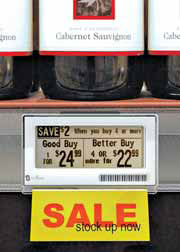
Labels from Altierre, a California company, help keep prices up to date. Altierre |
Think of this: a typical grocery store in the United States puts 5,000 items on sale in a week and removes sale prices from another 5,000. That creates a wealth of opportunities for mismatches when workers print out the new price labels in a back room, then hunt for the shelf to attach them.
This has left store technology in an incomplete state: mostly but not entirely computerized. The next step is to go completely paperless by putting small, battery-powered digital price tags on the shelves. Price changes can then be received wirelessly from the store's network, ensuring that the price displayed on the shelf and the one at the checkout are the same.
Altierre, a digital tag and sensor maker based in San Jose, California, has raised more than $80 million from investors and spent 10 years developing the technology for digital tags and the wireless networks they require. It asserts that outfitting a store with 20,000 to 25,000 tags, each costing about $5, would produce labor savings that would pay back the investment in about two years.
To reduce power consumption, Altierre uses black-on-gray liquid crystal displays, or LCDs, the same type used in digital watches.
Sunit Saxena, head of Altierre, explained why grocery stores haven't leapt at the chance to save money by installing the tags. "They're treading carefully because the fear is, they'll put 30,000 of these in a store where people are used to seeing paper and it will be a drastic change," he said. "They worry that their sales will drop."
In France, customers are accustomed to digital signs in grocery stores, where an LCD tag has been on shelves for about 10 years, says Michel Itie, an I.T. consultant. It requires a separate paper tag to show an item's name.
Mr. Itie is working with a company that is installing Altierre's technology for the hypermarket chain E.Leclerc, which has installed 300,000 new LCD tags in 10 stores and plans to deploy a total of two million tags by year-end.
In the United States, grocery stores still cannot justify making the investment in digital tags, says Patrick C. Fitzpatrick, president of Atlanta Retail Consulting. "If the payback was advantageous, you'd see them everywhere."
So far, the only company in the United States that has adopted Altierre's technology is Kohl's, the department store chain. It uses a large-format LCD screen that sits atop, say, a rack of clothes, showing a description and a sale price.
Mr. Saxena of Altierre says the LCD displays at Kohl's serve a limited purpose, providing prices once a customer is drawn to an item. Attracting the customer is the responsibility of colorful paper signs that accompany each of the LCD rectangles tags.
Digital tags look best when they remain small and modest. Seeing thousands of them on shelves seems rather strange at first glance. But not so much at the second. After the third, paper price tags look as quaint as a rotary-dial telephone.
The New York Times
(China Daily 03/03/2013 page11)