Going home? or Going away?
Updated: 2013-02-03 08:46
By Mu Qian(China Daily)
|
|||||||


|
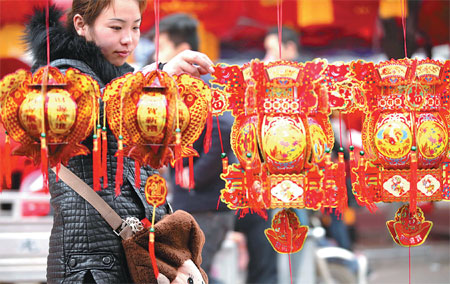
Shopping for decorative lanterns is popular now, since the New Year celebration ends with the Lantern Festival. Liu Qinli / Xinhua |

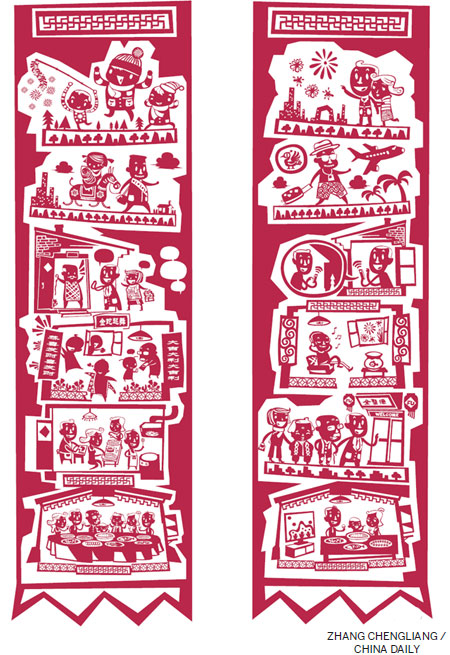
Not everyone in China will celebrate Spring Festival the traditional way this year. Modernization and urbanization have changed how some young Chinese think about this time-tested family holiday. Mu Qian reports.
A family reunion dinner, firecrackers, visiting friends and relatives, handing out red envelopes, and putting up couplets around the house used to be part and parcel of Wang Lei's Lunar New Year celebrations at his home in the Henan province countryside. But not this year. Instead of returning home, the 26-year-old Beijing cellphone salesman will travel with friends to Hunan province during the upcoming Lunar New Year to have some fun.
He will set out on the first day of Lunar New Year, also known as Spring Festival, and return to the capital before the holiday ends, along with everyone else who has a hectic work schedule.
"The Lunar New Year holiday is a good time to travel, as there are fewer tourists," he comments.
Wang says Lunar New Year is not as atmospheric as it used to be in his hometown. Most of the young farmers have left to become migrant workers in more developed eastern areas, and many return only every two or three years.
As for Wang's family, his parents will spend this Spring Festival with his sister in Xiamen, Fujian province, while Wang intends to see his parents in the summer instead.
Leisure travel has become a popular activity around this time after it became a "golden week", or seven-day public holiday, in 1999.
Li Xiang, a young office worker in Beijing, traveled to Guangxi Zhuang autonomous region during the Spring Festival holiday two years ago.
"I wouldn't say it's the best way of celebrating the occasion, but the holiday is the longest of the year for many people to travel," she says.
Li often wavers between vacationing on her own, or seeing her parents in Jilin province during the Lunar New Year. This year she has decided to do the latter. "I love traveling, but I also want to be with my parents," she says. "I wish I could compromise by traveling with them."
Li is planning to do just that next year. Although her parents are not used to celebrating the festival in this way, Li says she intends to persuade them and believes they will enjoy it.
Lunar New Year is traditionally a time for family reunions, just like Christmas is in the West. Originating in the Han Dynasty (206 BCAD 220), it takes place around the turn of the year in the Chinese lunar calendar.
Held during the slack season for farming, it traditionally consists of a long series of rituals and activities. It formally starts on Lunar New Year's Eve and ends with the Lantern Festival that falls on the 15th day of the first lunar month.
The most important event is the family reunion dinner on New Year's Eve. In Northern China, people make dumplings to eat around midnight. In the south, it is customary to make a glutinous New Year cake.
The first day of Lunar New Year is for visiting senior members of the extended family. Those who are married give red envelopes containing cash to youngsters as a form of blessing.
On the second day of the first lunar month, married couples typically visit the wife's parents and relatives.
The fifth day is when people eat dumplings and let off firecrackers.
The New Year celebration ends with the Lantern Festival, when people eat yuan-xiao, sweet glutinous rice balls brewed in a soup, and families walk the streets carrying lighted lanterns.
Few people today have the luxury of staying with their family for 16 days and observing all the rituals. The official public holiday starts on Lunar New Year's Eve and ends on the sixth day of the first lunar month.
"Since the 1980s, the rapid pace of modernization and the influence of globalization have greatly challenged the traditions of Lunar New Year," says Gao Bingzhong, a professor at Peking University's Institute of Sociology and Anthropology, and secretary-general of the China Folklore Society. "Urbanization of the rural areas has also undermined use of the lunar calendar."
This switch dates back to as early as 1912, when the Republic of China government officially adopted the Gregorian calendar.
During the turmoil after the founding of New China in 1949, Lunar New Year was regarded as a feudal tradition that required updating. As such the public holiday was canceled between 1967 and 1979, and people were exhorted to spend a "revolutionary" Lunar New Year instead.
But it is the economic development of the past three decades that has created the greatest challenges for the traditional festival.
With the increase in mobility, Lunar New Year involves more traveling than in the past. Every year huge waves of people return home to spend the holiday with their families, creating the world's largest annual migration.
The National Development and Reform Commission estimates a record-breaking 3.4 billion journeys will take place during the 40 days around the 2013 Lunar New Year.
Getting train tickets during this period can be so difficult that it deters many people. According to a survey by the China Association of Social Workers, an organization under the Ministry of Civil Affairs, nearly 70 percent of people surveyed become anxious about returning home for the festival. Getting train or plane tickets is the major concern.
For couples who come from different regions and live in a third place, it is even more troublesome. This is a common situation in big cities like Beijing, Shanghai and Guangzhou.
For those lucky couples who can get tickets home, the festival is usually divided among the two families and becomes a tiring event.
For those who are from the countryside or small towns, but work in the major cities, the contrasting lifestyles can also be a cause of discomfort.
Some people are reluctant to see their parents and relatives who live in the countryside because they fear they will be pressured by the traditional values of their elders relating to marriage or raising the kids.
And the conspicuous consumption of the holiday season can be an additional burden.
A China Association of Social Workers survey suggests those who are originally from the countryside are even more worried about returning to their hometown for the holiday than those who were born in the cities.
Yet, despite the challenges and difficulties, the majority of Chinese still choose to celebrate Lunar New Year with their families. There are numerous stories on the Internet of people going home in jammed trains, by motorcycle or in shared cars.
"I think celebration of Lunar New Year may change in form, but it will always be the most important family reunion," says Li Xiang, the Beijing office worker. "When I have a child, I will tell him or her the origins of Lunar New Year and why we celebrate it."
Contact the writer at muqian@chinadaily.com.cn.
(China Daily 02/03/2013 page1)