The new capital of malls: Moscow
Updated: 2013-01-20 07:59
By Andrew E. Kramer(The New York Times)
|
|||||||


|
Russians spend 60 percent of their pretax income on retail. Shoppers at the Mega Belaya Dacha mall and discount outlets outside Moscow. Photographs by James Hill for The New York Times |
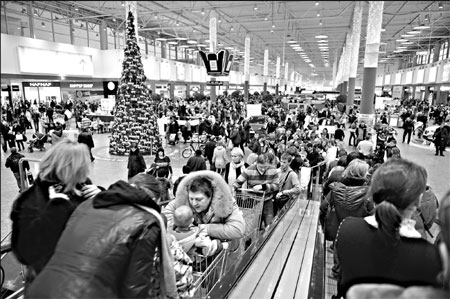
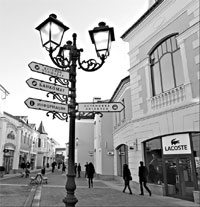
MOSCOW - Shoppers who find that 250 stores aren't enough can go ice skating, watch movies or even ride a carousel, all under a single roof.
"I feel like I'm in Disneyland," Vartyan E. Sarkisov, a shopper toting an Adidas bag, said recently while making the rounds of the Mega Belaya Dacha mall outside Moscow.
Instead of bread lines, Russia is known these days for malls. They are booming businesses, drawing investments from sovereign wealth funds and Wall Street banks, most recently Morgan Stanley, which paid $1.1 billion for a single mall in St. Petersburg.
One mall, called Vegas, rose out of a cucumber field on the edge of Moscow and became, its owners say, larger than the Mall of America in Minnesota if the 390,000-square-meter American mall's three-hectare amusement park is not counted in the calculation of floor space.
Moscow, the new capital of malls, has more floor space in malls than any other European city, with 3.15 million square meters. And a new record-setter is going up. Avia Park in northwest Moscow will have 464,500 square meters of interior space including covered parking, which will make it the largest mall in the world outside Asia.
Another Russian mall scored a different kind of victory: the Mega Tyoply Stan shopping center drew 57 million visitors at its peak in 2007, well ahead of the 40 million annual visits reported by the Mall of America.
So, the market is buzzing. Morgan Stanley is in talks to buy another mall, the Metropolis in Moscow, for more than $1.2 billion, according to real estate professionals.
As American malls struggle in old age, many of their stores vacant, Russia's shopping centers are just now blossoming into their boom years, nourished by oil exports that are lifting wages.
"It's 1982 all over again in Russia," said Lee Timmins, the country representative of Hines, a Texas-based real estate group that is opening three outlet malls in Russia, referring to the heyday of the American mall experience. Russians, he said, love malls.
The mall boom illustrates an extraordinarily important theme in Russian economics these days.The growing crowds at malls, and the keen interest in Russian malls on the part of Wall Street banks, are signs that the emerging middle class that made up the street protests against Vladimir V. Putin in Moscow last winter is becoming a force in business as well as politics.
"Over the past 10 years, Russia has turned into a middle-class country," said Charles Slater, an analyst at Cushman & Wakefield, a global commercial real estate firm. "What better to do than go to an enclosed, warm environment with many things on offer, whether that be bowling, cinema or food courts, things the customers have not been used to in the past?"
Moscow now has 82 malls, including two of the largest in Europe. Both are owned by Ikea Shopping Centers Russia, the branch of the Swedish assemble-it-yourself furniture franchise that manages 14 malls here.
In Russia, malls are still novel; the first Western-style suburban mall opened in 2000. They are now changing hands as developers sell to institutional investors, shedding light for the first time on their high values. Morgan Stanley is in talks to buy the Metropolis mall in Moscow for more than $1.2 billion, according to real estate professionals.
At the core of the attraction for investors is the rising disposable income of Russians, nudged along by policies favoring the middle class, lest their challenge to President Putin's rule intensify. Russia has a flat 13 percent income tax rate. Most Russians own their homes, a legacy of post-Soviet privatizations, and so pay no mortgage or rent. Health care is socialized.
Not surprisingly, then, Russians have become fanatical shoppers. Russians spend 60 percent of their pretax income on retail purchases, a category that includes food, according to Jones Lang LaSalle, a real estate consulting firm. The country in second place in Europe is Sweden, where retailing accounts for 40 percent of total private spending. Germans, by comparison, spend 28 percent of their salaries shopping, according to Jones Lang LaSalle.
A megamall built for Russians, not surprisingly, is subtly distinct from the idealized urban environment preferred by Americans, a result of careful analysis of consumer behavior and Russian retailing desires.
Most Russian malls have a huge grocery store as an anchor tenant, rather than a department store. Russians are still struggling to find groceries in their neighborhoods. And the sight of row upon row of groceries, stacked to the ceiling, surely soothes a lingering sore spot in the soul of Russian women who were compelled, just two decades ago, to serve their children such items as canned seaweed and powdered milk.
But Olga N. Zaitsova, 55, who was in the Mega Belaya Dacha mall with her granddaughter Anastasia, said she came every weekend, drawn by the warm play area for toddlers. "It's just not comfortable to be outside when it's so cold," she said.
When she shops, she said, "now we buy things we want, not things we need."
The New York Times
(China Daily 01/20/2013 page9)