A drive toward automation
Updated: 2013-01-20 07:59
By John Markoff and Somini Sengupta(The New York Times)
|
|||||||


|
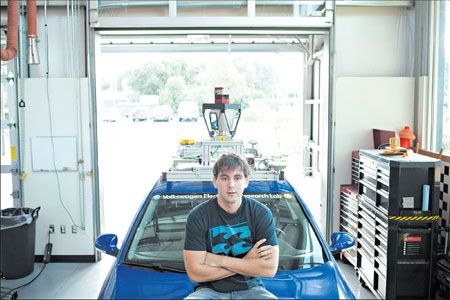
Jesse Levinson, a research scientist at Stanford University in California, has developed safety and driving systems that can detect obstacles. Annie tritt for The New York Times |
Cars that run themselves pass test
Palo aito, California
Jesse Levinson does not much worry when he drives his prototype Volkswagen Passat around the Stanford University campus here. A computer vision system he helped design keeps an unblinking watch for pedestrians and cyclists, and automatically slows and stops the car when they enter his path.
Someday soon, few drivers will have to worry about car crashes and collisions, whether on congested roads or on empty highways, technology companies and car manufacturers are betting. Even now, drivers are benefiting from a suite of safety systems, and many more are in development to transform driving from a manual task to something more akin to that of a conductor overseeing an orchestra.
An array of optical and radar sensors now monitor the surroundings of a growing number of cars traveling the highways around the world, and in some cases even track the driver's physical state. Pedestrian detection systems like the one that Dr. Levinson, a research scientist at Stanford's Center for Automotive Research, has helped design are already available in luxury cars and are being built into some midrange models.
The systems offer auditory, visual and mechanical warnings if a collision is imminent - and increasingly, if needed, take evasive actions automatically. By the middle of this decade, under certain conditions, they will take over the task of driving completely at both high and low speeds.
But the new systems are poised to refashion the nature of driving fundamentally long before completely autonomous vehicles arrive.
"This is really a bridge," said Ragunathan Rajkumar, a computer science professor who is leading an automated driving research project at Carnegie Mellon University in Pittsburgh, Pennsylvania, partly financed by General Motors. "The driver is still in control. But if the driver is not doing the right thing, the technology takes over."
Carnegie Mellon's Autonomous Cadillac SRX can drive itself on public roads, detect and stop for pedestrians, and communicate with traffic signals.
A host of related legal and insurance issues have already arisen, and researchers are opening a new line of study about how humans interact with the automatic systems.
The safety systems are the result of rapid advances in computer algorithms and the drastically falling cost of sensors.
Four manufacturers - Volvo, BMW, Audi and Mercedes - have announced that as soon as this year they will begin offering models that will come with sensors and software to allow the car to drive itself in heavy traffic at speeds up to 60 kilometers per hour. The systems, known as Traffic Jam Assist, will follow the car ahead and automatically slow down and speed up as needed, handling both braking and steering.
At faster speeds, Cadillac's Super Cruise system is intended to automate freeway driving by keeping the car within a lane and adjusting speed to other traffic.
Already, actions like steering, braking and accelerating are increasingly handled by computer software rather than the driver.
"People don't realize that when you step on antilock brakes it's simply a suggestion for the car to stop," said Clifford Nass, a director at the Center for Automotive Research at Stanford. How and when the car stops is left to the system.
The automobile industry has been motivated to innovate by growing evidence that existing technologies like the antilocking braking systems and electronic stability control have saved tens of thousands of lives. In November, the United States National Transportation Safety Board recommended that all new cars be equipped with collision avoidance technologies.
The National Highway Traffic Safety Administration recently reported that one system, electronic stability control, or E.S.C., which digitally detects the loss of traction and compensates automatically, saved 2,202 lives from 2008 to 2010.
Innovation and deployment of the crash-resistance technologies grew after 2010, with news that Google had a secret program to design self-driving cars. Google has not said whether it intends to sell its vehicles. However, it has actively lobbied for laws in several states legalizing autonomous automobiles. Also playing a role in the speed with which safety changes are being made are component suppliers like Bosch and Mobileye, an Israeli company that specializes in cameras mounted to look forward from the car's rearview mirror, and elsewhere on advanced vehicles.
An emerging communications technology that will give vehicles a much more elaborate and instantaneous view of their surroundings is being tested in Ann Arbor, Michigan; Europe and elsewhere.
Dr. Rajkumar said: "In time, as society becomes more comfortable and legal concerns are ironed out, full autonomy will become practical, inevitable and necessary."
The New York Times
(China Daily 01/20/2013 page9)