Prepare to be amazed at caves
Updated: 2013-01-06 08:39
By Erik Nilsson(China Daily)
|
|||||||


|
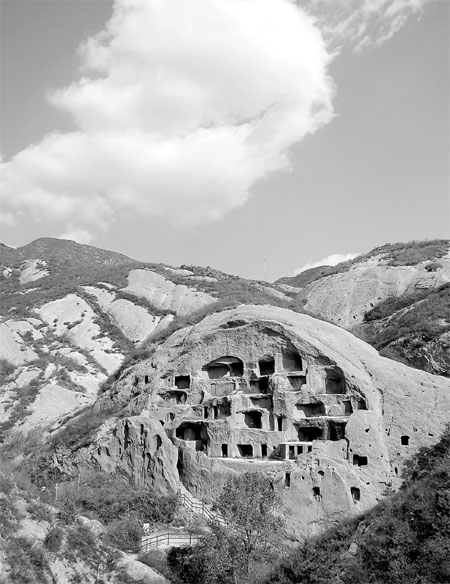
The Guyaju, a cliff-dwelling settlement, consists of 350 chambers whittled inside 117 caves. Erik Nilsson / China Daily |
There are many theories about the caves bored out in the cliffs of Zhangshanying, reports Erik Nilsson, but they are certainly worth a visit.
While a hole in a wall is undesirable real estate today, it was ideal accommodation for a mysterious people who settled north of Beijing about 1,000 years ago.
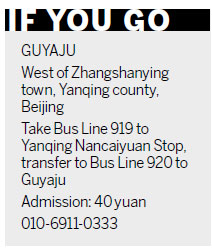
No written record mentions the population who bored the caverns of the country's largest cliff-dwelling settlement in today's Zhangshanying town, Yanqing county, about 90 km northwest from the downtown capital.
But they carved in stone a lasting legacy that reveals little except they existed and were erudite at digging and defense, before vanishing into thin air.
One point archeologists agree on is that "China's biggest maze" - as the site is colloquially known - would have been virtually impenetrable.
The 350 chambers whittled inside 117 caves were hacked into the cliff sides in a valley fewer than 10 meters across. They pock a 5-km span.
These perforations in the crag are labyrinthine in arrangement.
Some are connected vertically, while others are linked horizontally and a few are adjoined both ways.
Some are single rooms, while others are clusters. A plexus of stone steps and ladders enable access to the 3-20-square-meter stone chambers.
They still house beds, ovens, tables and feed troughs sculpted into the rock. These ancient engineers also designed ventilation and drainage systems for their hive.
Generally speaking, the bottom cavities housed livestock, while the "middle class" dwelled in the center tier of burrows.
But the function of the "King's Palace" - the spacious top-floor penthouse, if you will - remains an enigma.
Most experts believe the name is a misnomer and are skeptical this was the chieftain's abode.
The two-story structure with six side chambers and decorative pillars (none of the structures required beams to support their ceilings) was likely used for community meetings, sacrifices and religious ceremonies.
A massive stone table in the center suggests it might have been a banquet hall.
But the "palace's" function is as cryptic as that of Guyaju itself.
Some believe the compound is a bunker beneath a lost beacon tower of the Han Great Wall. Others contend it was a bandit lair or a military outpost during the Tang Dynasty (AD 618-907).
The most popular theory is that Guyaju was a haven for the ethnic Xi, a tribe that fled bondage or war under the Liao Dynasty (AD 916-1125).
Be they outlaws, war refugees, soldiers, or someone else altogether, it's almost certain they had little inkling they would literally shape curiosity about their lives a millennia later.
But that's exactly what these ancient people did when they chiseled the cliff-side dwellings that would become a heritage site for modern visitors to wonder at - and about.
Contact the writer at erik_nilsson@chinadaily.com.cn.
(China Daily 01/06/2013 page15)