Hong Kong banks on yuan for the future
Updated: 2012-07-01 08:05
By George Ng in Hong Kong(China Daily)
|
|||||||


"Unique positioning" is a crucial factor for maintaining the competitive edge of an international financial center. Hong Kong, however, lags in this aspect compared with its peers like London, a major offshore dollar market, and Zurich, which has an edge in offshore asset management businesses. But with the rapid development of the offshore yuan businesses in Hong Kong, it is only a matter of time before the city catches up with its rivals.
The offshore yuan market has grown at a breakneck pace in Hong Kong in the past few years as investors, traders and banks scrambled for the currency amid strong expectations of appreciation against a chronically declining US dollar, the world's reserve currency.
"Along with its favorable policies, Hong Kong has also become a major offshore yuan center," wrote Norman Chan, chief executive of the Hong Kong Monetary Authority. The policy support stems from China's continued efforts to push for wider use of the yuan in the international market, and the underlying desire to safeguard its financial interests and financial stability. The value of China's huge foreign exchange reserves, estimated at $3.18 trillion at the end of 2011, is also in danger of being significantly eroded by the falling US dollar, experts say.
Hong Kong, which had served as a gateway between the Chinese mainland and the world before the country implemented the reform and opening-up policy in the 1970s, naturally became the testing ground for the internationalization of the yuan.
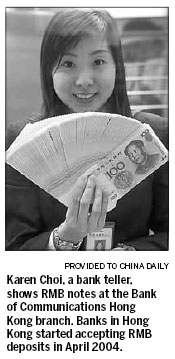
Yuan businesses in the city, which officially started in February 2004, initially got off to a slow start and unbridled growth was not seen until the central government permitted the settlement of cross-border trade in yuan.
Since the State Council approved the pilot scheme for yuan cross-border trade settlement in July 2009, the use and circulation of the Chinese currency in Hong Kong's offshore market has increased considerably. The total value of yuan trade settlements handled by banks in the city surged by more than 400 percent to 1.91 trillion yuan ($300 trillion) in 2011 from the previous year, according to data provided by the HKMA. During the first quarter of this year, 580.4 billion yuan worth of the mainland's foreign trade was settled in yuan, of which the banks in Hong Kong handled 98 percent.
With Hong Kong banks handling the bulk of the yuan trade settlement businesses by far, the city has also established itself as the global hub for yuan trade settlement. More importantly, yuan trade settlement also has huge potential for growth, based on the growth projections for the next few years.
Official statistics show that the percentage of the mainland's total trade settled in yuan has increased from 0.7 percent in the first half of 2010 to 4 percent in the second half of 2010, and further to 9 percent in the first half of 2011.
The rapid growth in yuan trade settlement has also helped effectively expand the yuan liquidity pool in Hong Kong, facilitating the development of yuan-denominated products in the city. By the end of 2011, yuan deposits stood at 588.5 billion yuan, up from 314.9 billion yuan at end of 2010 and less than 100 billion yuan as of late 2009, according to data provided by the HKMA.
The ample yuan liquidity and the relatively cheap funding costs have attracted many mainland and international financial institutions and companies to raise yuan capital in Hong Kong.
Yuan-denominated bonds issued in Hong Kong doubled in the first four months of 2012 to 36.7 billion yuan from the corresponding period in 2011, while outstanding yuan lending as of March 31 rose to 42 billion yuan compared with 30.8 billion yuan at the end of 2011, the HKMA said on May 15.
An offshore yuan wealth management center is also in the offing and so are other yuan-denominated products such as gold trading and equity offerings.
The city's development as a yuan offshore center has reinforced the financial linkages with the mainland, and this process is set to continue, leading to more systemic integration, according to a Chatham House report released in May.
george@chinadailyhk.com
(China Daily 07/01/2012 page5)