Locavores from the Hani hills
Updated: 2012-05-13 07:50
By Pauline D. Loh and Cang Lide(China Daily)
|
|||||||


The Hani people have a great love and respect for the land. According to tribal tales passed down through word of mouth, this land gave them refuge when they were persecuted and pursued and their wise ones had gradually learned to carve out rice terraces on the sides of the rolling hills.
These rice terraces are now one of Yunnan's main tourist attractions, drawing flocks of photographers all year round.
They are not easily accessible, however, and if you travel from Kunming, it takes about six hours of hard driving, more than half of which is on winding mountain roads.
By the time you reach the Honghe Hani and Yi autonomous prefecture, you are almost at the Vietnam border.
But take the trip and absorb some valuable lessons from the people here, people who have guarded an eco-friendly lifestyle for countless generations, people who fall back on tribal wisdom carefully passed down by their ancestors.
We had the honor of dining with some of the most passionate advocates and protectors of the region's green ecology last month, and it was over lunch that I learned the most.
Zhang Hongzhen, director of the Honghe Rice Terraces Management Board, hosted the China Daily team for lunch at the Hani Renjia Restaurant in Mengzi, one of two county-level cities in the prefecture.
She is the most passionate advocate of them all, and when she talks about the rice terraces, her eyes light up with the pride of her Hani heritage.
"Everything we need comes from the rice terraces. The rice we eat, the vegetables even the meat." Zhang's laid-back description is pure understatement.
The Hani hill terraces have traditionally been planted with ancient varieties of rice, often a red rice that is full of fiber. Before the rest of the world was expounding the benefits of unpolished rice, the Hani people were already eating it as a staple.
When the rice terraces are planted in the spring or early summer, usually around the first week of May, ducklings are also released into the fields, where they grow fat on grubs and insects and stir up the soil around the seedlings, releasing nutrients that help the rice plants grow better.
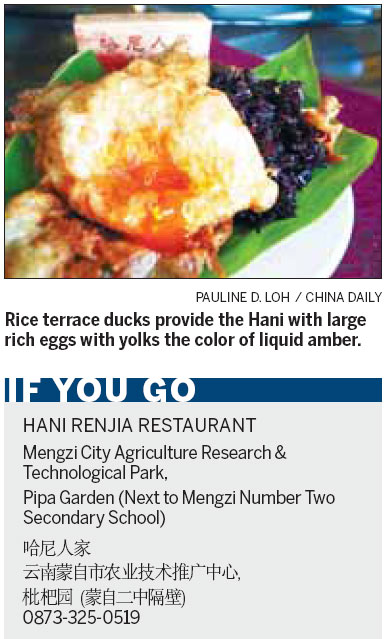
And when the birds are grown, they provide the Hani with large rich eggs with yolks the color of liquid amber.
In the water, too, are loaches, slippery fish that thrive in the flooded terraces and provide much needed protein for the Hani diet.
There is also insect protein.
Dragonfly larvae, ferocious carnivores that live underwater for a large part of their lives, are harvested from the terraces as well. Fried, steamed or added to a duck-egg omelet, they are delicious and nutritious.
On the bunds of the paddy fields, all sorts of wild and cultivated vegetables grow. Much of the greens in the markets are also foraged from the mountainsides, and may include herbs, mushrooms or even tree lichens that are much appreciated as a salad dish.
As one Hani elder later tells us, these herbs are valuable as food, and also as medicine, and can cure anything from a common cold to chronic arthritis. For the latter, you have to start with an old gander that is 10 years old and you eat everything from its meat to its ground-up bones.
Generally, nothing goes to waste. Each and every element of the Hani rice terraces is carefully protected and maintained, including a natural irrigation system that takes advantage of the region's topography and a micro-climate that depends on convection.
Water evaporates from the heated valleys and condenses as rain when the mists gather on the thickly forested mountaintops.
The only reason why the ecology is so successful is the respect for nature that is more lifestyle necessity than casual choice, and that's the lesson the urban populace has to learn before it's all too late.
(China Daily 05/13/2012 page14)