Frog in the Palace
Updated: 2012-01-29 08:00
By Rebecca Lo(China Daily)
|
|||||||


|
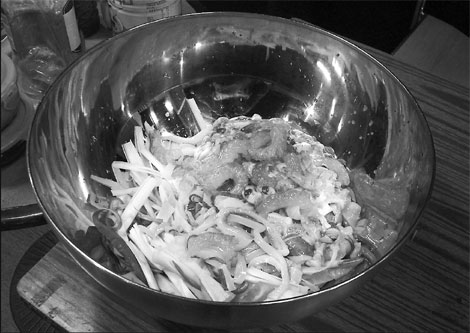
Cho Hyun-hae prepares the freshest ingredients for haemul pajeon, a kind of pan-fried Korean savory seafood pancake. Photos by Rebecca Lo / For China Daily |
South Korean artist Cho Hyun-hae indulges her passion for slow food at her Pyeongchang farm and in Hong Kong. Rebecca Lo explains why they call her the Frog Queen.
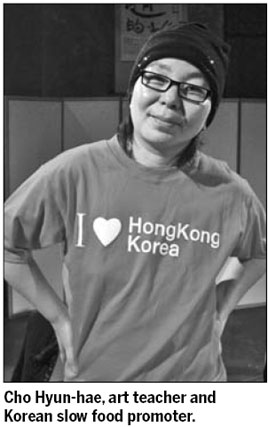
Cho Hyun-hae is the perfect ajumma. Yes, she is middle-aged and yes, she is married, as the term ajumma implies. She is also hip, fun and passionate about art and food.
Sporting a black toque sparkling with rhinestones and a red T-shirt emblazoned with her love for her adopted city of Hong Kong and her homeland of South Korea, she dishes out plates of chicken salad dressed with a sauce made from doenjang while deftly snipping freshly pan-fried seafood pajeon, a Korean savory pancake.
Patient audience members who stayed for the length of her 90-minute talk on Korean slow food were treated to sauces, pastes and preserved vegetables flown in from her farm in the hills of Pyeongchang, a county about three hour's drive from Seoul where the 2018 Winter Olympics will be held.
Cho is also known as Frog Queen - her husband is Hong Kong installation artist Kwok Mang-ho, dubbed Frog King as many of his drawings sport frog characteristics. Born in Chuncheon, she studied fine arts at Duksung Women's University and education at Dongkuk University. Hong Kong has been her home since 1997.
Her day job is actually teaching art at Kwok Art Center; every summer, she returns to South Korea for three months and teaches art at a camp in Pyeongchang.
"People can come for one or two weeks and everything's included: accommodation, food and classes," Cho explains. "They can enjoy fresh air and we can wander into the forests to pick mulberry leaves or other things to make art."
Cho considers organic farming an art as well as a hobby. "Slow food helps to preserve traditions and regional styles of cooking," she says. "Cheonggukjang - a boiled then fermented soybean paste - is rich in vitamins and has been linked to the prevention of colon cancer."
She stores doenjang and cheongukjang in large clay pots stacked neatly on an outdoor jangdokdae, a 30-by-60-meter platform raised about one foot high to protect them from the elements while they ferment.
While historically kimchi was made by villagers as a fall tradition and stored underground in jars to be eaten throughout the winter, today it is available anytime in supermarkets all over the world. It has a high concentration of fiber, with one serving providing 80 percent of the daily requirement for vitamin C and carotene. Due to its nutritional benefits, kimchi is known to improve the respiratory system and studies are being conducted to show it is beneficial for cancer prevention.
"Many people think that Korean food is meat-based," she says. "Actually, the daily foods that many people in the countryside eat are mostly vegetables and preserves."
To learn more about Korean slow food and Cho's art farm, call 852-9731-3783 or e-mail frogqueencho@gmail.com.
You may contact the writer at sundayed@chinadaily.com.cn.
(China Daily 01/29/2012 page15)