Pate and skydiving: Animals also relish pleasure and thrills
Updated: 2011-07-31 08:29
By Katherine Bouton(The New York Times)
|
|||||||


|
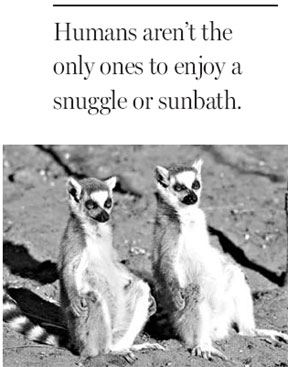
An animal behaviorist believes creatures seek fun in their lives. Ring-tailed lemurs in Madagascar seem to enjoy a sunbath and young Asiatic lions play in India. Photographs by Steve Mandel |

Two ring-tailed lemurs, perhaps a pair, perhaps just two guys out to enjoy the heat, sit side by side tilted back as if in beach chairs, their white bellies exposed, knees apart, feet splayed to catch every last drop of the Madagascar sun. All they need are cigars to complete the picture.
There's a perfectly good evolutionary explanation for this posture. Scientists use the term "behavioral thermoregulation" to describe how an animal maintains a core body temperature. But as the animal behaviorist Jonathan Balcombe points out in his exuberant look at animal pleasure, "The Exultant Ark," they are also clearly enjoying themselves. A scientist through and through, Dr. Balcombe can't help giving the study of animal pleasure a properly scientific name: hedonic ethology.
True to the book's subtitle - "A Pictorial Tour of Animal Pleasure" - "The Exultant Ark" showcases surprising, funny, touching, sad, heartwarming pictures by photographers all over the world. Dr. Balcombe's text is a serious examination of the subject of animal pleasure, a study that "remains nascent and largely neglected in scientific discourse." But it also delights us along the way with Dr. Balcombe's observations and examples.
On the subject of food as pleasure, for instance, he tells us, "Rats will enter a deadly cold room and navigate a maze to retrieve highly palatable food (e.g., shortbread, pate or Coca-Cola)." If they happen to find rat chow instead, "they quickly return to their cozy nests, where they stay for the remainder of the experiment."
Dr. Balcombe offers three primary arguments in support of the case that animals feel pleasure. First, pleasure is adaptive: Just as "pain discourages animals doing things that risk harm or death, which are not good outcomes in the evolutionary stakes," he writes, pleasure "is nature's way of improving survival and reproductive output."
Second, we know for sure that pleasure exists in at least one animal species: humans. Dr. Balcombe argues that animals may experience their own unique pleasures, "forms of pleasure inaccessible to humans."
His third argument is simply that animals are equipped to feel it. Since we know animals experience pain, why not pleasure?
Sex is a pleasure that in humans clearly has some nonprocreative aspects. But Dr. Balcombe points out that this is true in the animal world as well. He gives numerous examples; one particularly racy one (not pictured) is a pair of manatees embracing "with each male's penis in the other's mouth."
"Love" is a term scientists are reluctant to apply to animals, preferring "bonding" and "attachment." But look at the photograph (by Vicki Puluso) of two adult giraffes nuzzling a calf, the baby's eyes half closed in bliss. Or a Japanese macaque cradling her infant (by Robert Parnell). Call it love or call it bonding, but, Dr. Balcombe writes, "the hormones are exactly the same in a human and a vole" - one of the most studied animals in the realm of emotional attachment - "and the evolutionary benefits align."
Animals exhibit a variety of behaviors that certainly look like pleasure, and for which no evolutionary explanation seems obvious. We've all seen gulls or crows diving precariously toward the ground before swooping up at the last moment. "There is no obvious survival function to this behavior," Dr. Balcombe writes, "which leaves me wondering if they do it simply for the thrill of speed, as a human skydiver might."
Every once in a while, Dr. Balcombe seems to drift a little too close to anthropomorphic supposition. Musing about a picture of a fledgling osprey, he writes, "I surmise that the feelings are similar" to those of a human "launching off a high aerie," a feeling that is both "thrilling and terrifying."
In his conclusion Dr. Balcombe argues that an animal's ability to experience pleasure is a strong factor in considering the rights of animals. "The real arbiter of whether or not a being deserves respect and compassion is sentience," he writes. "Being sensate to pleasures and especially to pains is the true currency of ethics."
It's hard to deny that animals are not sensate to pleasure after reading Dr. Balcombe's persuasive arguments.
The New York Times
(China Daily 07/31/2011 page12)