Universiade athletes turn to music to beat stress
Updated: 2011-08-09 11:51
(sz2011.org)
 |
|
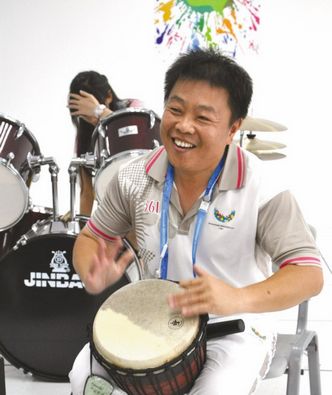
Inside the Music Therapy Center, the music therapist, Ke Bo, is demonstrating the service to the journalists. |
Sitting on comfortable leather armchairs and listening to music, athletes strive to keep stress at bay, at Ke Bo's Music Therapy Center in Universiade Village.
The 26th World University Games will run in Shenzhen from Friday to Aug 23.
"Music has its players and listeners, its professionals and amateurs, its teachers and students. Less widely recognized are music therapists like us, who use rhythm, melody and song to help treat a number of conditions," music therapist Ke Bo says.
The center, part of the Universiade for the first time, comprises four carefully decorated rooms, where a team of 13 trained music therapists help athletes by either listening to or creating music.
"There's a significant difference between simply listening to music and music therapy," says Ke, who's also a member of World Federation of Music Therapy (WFMT), the international non-profit organization based in the United States.
"People usually listen to music consciously, irrespective of whether they focus on the music itself or they regard it as background. However, the impact of that music on one's physical and mental state peters out once the music is switched off."
Ke says music "talks" to one's body and mind. "It's a bit like being in a trance that allows you to better approach your inner potential by hovering between the conscious and the subconscious."
The center offers two main kinds of music therapy. Sometimes, Ke will listen to music with a cilent and talk about the feelings or memories it evokes.
"This works for those who can't sleep well because of nervousness before the big day," Ke says.
A device clipped to the athletes' index fingers helps record physiological characteristics such as heart rate while they undergo the 20-minute therapy session. The results are then mapped out to produce a stress curve, Ke says.
The choice of music is a personal one. "Unfortunately, music therapy didn't come to China until 2000, so most of the available music (for therapy) is classical music from the West," Ke says.
"However, I do believe Chinese folk music is equally effective."
Some of the most common "music prescriptions" include Beethoven's Symphony No 6, Brahms Symphony No 2 and Debussy's Nocturnes. But Ke says he sometimes combines traditional folk music with Western classical.
The center also offers another kind of therapy, more suited to team players, that uses djembes, an African drum played with bare hands.
Clients who are too shy to come alone or those who prefer to work with a team are encouraged to play an instrument or two along with the therapist.
"We have Western instruments such as guitars and also Asian instruments such as the cucurbit flute" Ke says, referring to the pipe-like instrument unique to ethnic groups in China's Yunnan province.
"It doesn't matter if you are a professional (musician) or not - I am not. The group music therapy works as long as everybody participates to overcome nervous tension during the interaction," he says.
Video
Working as a Universiade volunteer
Party starts as Universiade ends

Sumptuous seafood in Shenzhen

Athletes test doping knowledge
About Shenzhen