 |
|
Wang Xiaoying / China Daily |
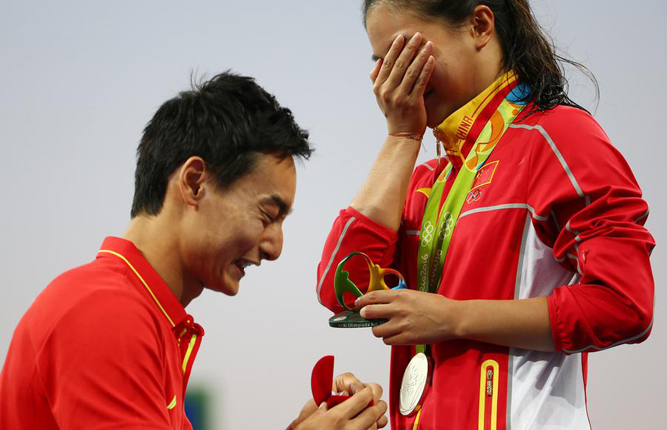
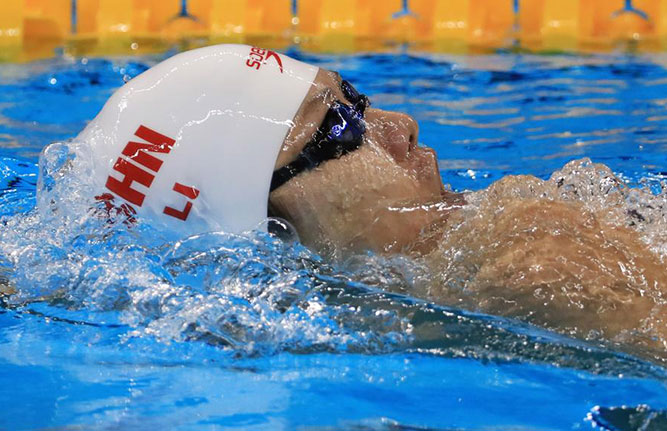
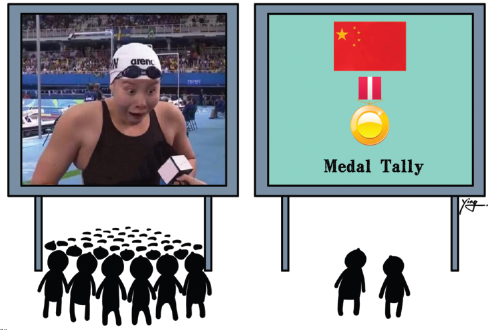
Of all the Chinese athletes taking part in the Rio Olympic Games, who is the most popular at home? No, it's not champion swimmer Sun Yang or any other gold medal winner, but Fu Yuanhui. And no, Fu did not win the gold; she came third in the women's 100 meters backstroke.
Fu was the hottest topic of discussion on China's social media afterwards. What has endeared her to sports fans is not the medal she won, but her excitement and down-to-earth answers during the two interviews she gave after the race.
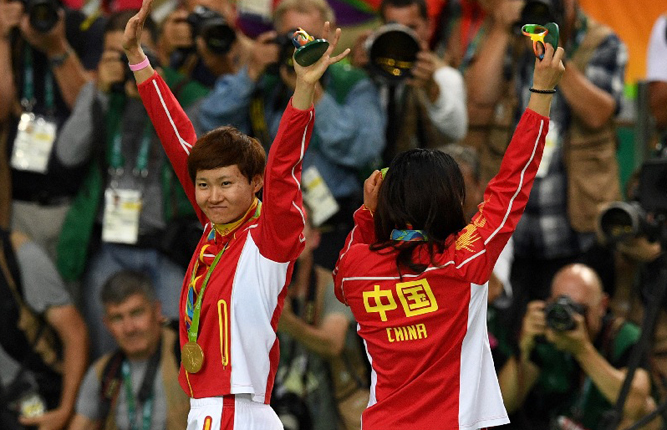
Compared with previous Olympics, when gold medals were the focus of almost all sports discussions in China, it seems the gilded medal is no longer the be-all and end-all.
Apart from Fu, her honest and feisty replies, Chinese sports fans' discussions have also veered round who is the most handsome athlete, the likes and dislikes of male and female athletes, as well as Australian swimmer Mack Horton's baseless doping accusation against Sun. In short, fans are discussing everything except gold medals.
And that's a welcome change, because gold medals should never be the central topic of people's discussion. Olympics is a stage where top players from across the globe compete for the honors, and the number of gold medals a country's athletes win does not signify the general physical health of its people.
This change in attitude would have been impossible had social networks not done their jobs. At the Beijing 2008 Olympics and the London 2012 Games, after every event Chinese athletes had tears in their eyes: Tears of joy for winning the gold or tears of sorrow for failing to win it.
But the emergence and flourishing of interactive social media changed the situation. Micro blogs allow fans at the competition venues to record videos and capture what they consider the most impressive moments of athletes. They also allow audiences at home to highlight the moments they consider most interesting.
The wide participation of audiences in the generation and dissemination of news has helped curb the craze for gold medals, because only the information the audiences consider truly interesting gets widely spread.
More importantly, as athletes, too, use social networks they get timely feedback and are thus more likely to interact with audiences in a relaxed way.
Another important factor for the change is the tolerant public opinion. Even officials who practiced stoicism appear more open to the feelings of athletes.
At the 2010 Winter Olympics in Vancouver, Canada, 19-year-old Zhou Yang from China won the gold in short-track speed skating. Full of joy, she thanked her parents on TV and said she hoped to improve their living conditions with the bonus she would receive. Those were the natural words of an athlete, but Yu Zaiqing, then deputy director of General Administration of Sport of China, criticized her and said: "She should thank the State first".
This time, though, the officials have shown more openness and tolerance. There are no reports about officials criticizing athletes for their comments to the media; even when Fu told her interviewers that she did not expect to win any medal in the final, she was applauded, not criticized. In the past, such words would have been considered politically incorrect, because an athlete was supposed to win the gold irrespective of his or her potential.
Tolerance is the new key word defining Chinese people's opinion about this Olympics, and we hope the trend continues.
The author is a writer with China Daily. zhangzhouxiang@chinadaily.com.cn

Copyright 1995 - . All rights reserved. The content (including but not limited to text, photo, multimedia information, etc) published in this site belongs to China Daily Information Co (CDIC). Without written authorization from CDIC, such content shall not be republished or used in any form. Note: Browsers with 1024*768 or higher resolution are suggested for this site.
License for publishing multimedia online 0108263 Registration Number: 130349