The Americans invented beach volleyball and Brazilians made it a passion.
But there's another country making waves at the Copacabana venue at these Olympics - one with little tradition of beach volleyball or even a lot of sun-splashed beaches, for that matter.
Canada. Yes, Canada.
The nation that produces the world's best curlers and ice hockey players is one of only four countries to qualify the maximum four teams - two men's and two women's - for the Rio Games.
Although Canada has won only one medal in the sport since it was added to the Olympic program in 1996, this Canuck contingent is hoping it can change that.
"Canada is a very competitive nation," said Ben Saxton, whose father was on the Canadian indoor volleyball team that finished fourth at the 1984 Olympics - its best finish ever.
"All of us want to win at every sport we play. Just because we can't play during the winter doesn't mean we aren't resourceful enough to find a way."
More often associated with the ice and snow events of the Winter Olympics, Canada has had its share of success in Summer Games events like track, rowing, swimming and diving.
But the beach has been barren since John Child and Mark Heese took bronze in 1996 at Atlanta.
True, it's difficult to compete with countries where the athletes can train year-round. The lack of volleyball history itself makes it hard to convince young Canadians to put down their hockey sticks and hit the beach, and Canada's population of around 35 million is smaller than California's, not to mention Brazil's.
"You take a couple of cities in Brazil and you've got more people than we have in the whole country," said Steve Anderson, Canada's head beach volleyball coach.
"You can't compete with the population. You can't compete with the history. People come to Brazil and the US to immerse themselves in the culture because you can't get that anywhere else."
But when Anderson took over the country's beach volleyball program, he decided the problem was the mindset of Canadians, who didn't think they could compete with the sport's powers.
Anderson, an American who coached Australia's Natalie Cook to the beach gold medal in 2000, asked the Canadian players: "When was the last time you got off the plane expecting to win an event?"
"Their answer was, 'That's a bit arrogant. That's not how Canadians think,'" Anderson said on Tuesday.
"But I don't know any Canadian hockey player that gets off a plane just to show up," he said.
"How do we change that mindset?"
Since London 2012, Canada has seen enough success on the world professional tour to hit the country quota of two teams in each gender in Rio.
Saxton and Chaim Schalk reached the podium five times on the FIVB tour; Josh Binstock, a 2012 Olympian, and Samuel Schachter have four top-three finishes since 2014.
On the women's side, Heather Bansley and Sarah Pavan were No 5 in the Olympic rankings, while Jamie Broder and Kristina Valjas were 13th.
The US and Brazil - which have combined to win 20 of the 30 total medals since 1996 - and the Netherlands are the only nations to qualify four teams for Rio.
|
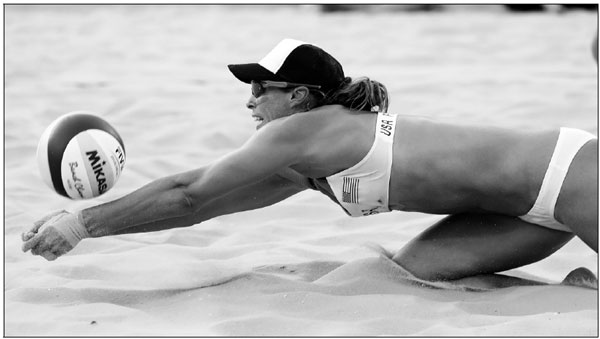
Lauren Fendrick of the United States dives for a return against Brazil during Tuesday’s beach volleyball match, Marcio Jose Sanchez / AP |

Copyright 1995 - . All rights reserved. The content (including but not limited to text, photo, multimedia information, etc) published in this site belongs to China Daily Information Co (CDIC). Without written authorization from CDIC, such content shall not be republished or used in any form. Note: Browsers with 1024*768 or higher resolution are suggested for this site.
License for publishing multimedia online 0108263 Registration Number: 130349