 |
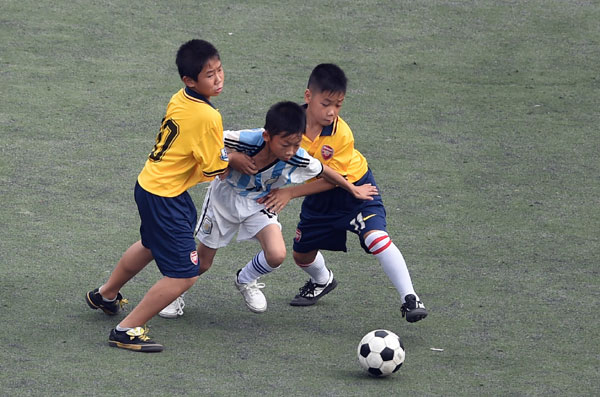
| Primary students compete to take control of a soccer ball during a match at Hubinlu Primary School in Nanning, Guangxi Zhuang autonomous region. The central government is working to encourage more youngsters to play soccer. HUANG XIAOBANG/XINHUA |
Despite China's bold ambition to develop soccer at the grassroots, the lack of soccer fields has hampered public participation, said a national survey on sporting venues.
The General Administration of Sport of China released the results of the sixth national survey on sporting venues and facilities on Thursday, which showed a significant increase of new sporting infrastructure during the past decade.
China had built more than 1.69 million sporting venues covering more than 3.9 billion square meters by the end of 2013, double the number of the venues in 2003. The per capita venue area increased to 1.46 sq m in 2013, up almost 42 percent from the figure in 2003.
However, the slow growth of new soccer grounds in the past decade has raised concerns, especially as the country desperately tries to encourage more people to play the game.
"How could more schools introduce soccer as a mandatory physical education course without adequate fields? There are fewer children playing soccer now because they have no safe place to play," Liu Hechun, a physical education teacher from Dongbeilu Primary School in Dalian, Liaoning province, said at a recent State Council meeting to discuss school soccer development.
According to the survey, 7,100 soccer grounds, including full-size and smaller five-a-side fields, which cover about 21.4 million sq m, were built in the past decade, a 0.02 sq m per capita increase.
"Building soccer fields is costly in terms of funding and urban land. It requires the joint efforts of the sports governing body, education authorities and urban planning departments, as well as real estate developers to draft long-term plans for improving the facilities," Chen Entang, vice-director of the General Administration of Sport of China's finance department, said on Thursday.
Located in congested downtown neighborhoods, only 20 percent of the 1,148 primary and secondary schools in Beijing were equipped with a full-size soccer field by the end of 2013, according to a survey released by the Beijing Education Association's Physical Education research board earlier this year.
"One of the solutions is to make preferential policies to encourage real estate developers to build small-scale street soccer grounds in communities," Chen added.
Chen also pointed out that China's per capita sporting ground area, which reflects a country's mass fitness development level, remains far behind world sporting powers like the United States and Germany.
To accelerate sport development, as well as public well-being, the State Council issued a national plan in October, urging the government to loosen its grip on the sports market while encouraging private investors and nongovernmental groups to further take part in sporting facility development and facilities for mass fitness participation.
The State Council set goals to increase the per capita venue area to 2 sq m by 2025.
Chen said the target could be achieved if the sporting facility construction potential in residential communities is fulfilled by urban planning.
Copyright 1995 - . All rights reserved. The content (including but not limited to text, photo, multimedia information, etc) published in this site belongs to China Daily Information Co (CDIC). Without written authorization from CDIC, such content shall not be republished or used in any form. Note: Browsers with 1024*768 or higher resolution are suggested for this site.
License for publishing multimedia online 0108263 Registration Number: 130349