Sprinter Gatlin to challenge doping ban
Updated: 2008-01-03 09:18
Olympic champion sprinter Justin Gatlin will challenge his four-year doping suspension and may take the case to federal court. "We may have to file multiple actions at the same time," Gatlin's attorney John Collins told The Associated Press on Wednesday.
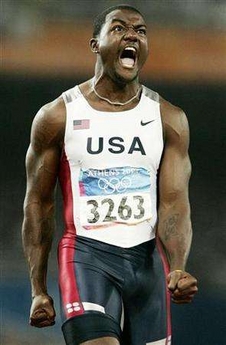 Justin Gatlin of the U.S. celebrates winning the men's 100 metres final at the Athens 2004 Olympic Games, August 22, 2004. Gatlin will challenge a four-year suspension for a 2006 positive doping test, his attorney said on Wednesday. [Agencies] |
A three-member arbitration panel voted 2-1 to suspend Gatlin, who faced a possible eight-year ban for his second doping offense, in a 53-page ruling released Tuesday.
Under the panel's ruling, Gatlin would be eligible to run May 25, 2010. That would prevent him from defending his
100-meter title at the Beijing Olympics this August. If the sprinter can get his first offense erased, it likely would result in a two-year ban that would expire this May, a month before the U.S. Olympic trials.
Asked if he thought any appeal or court action could be completed in time, Collins said, "I don't know. Obviously that's the goal."
He said he believes there is precedent for a U.S. court ruling to be applied internationally, but acknowledges that's not a certainty.
Gatlin tested positive for excessive testosterone at the Kansas Relays in April 2006. It was his second doping offense. As a 19-year-old competitor at the world junior championships, Gatlin tested positive for amphetamines, part of a prescribed medication he was taking for attention deficit disorder.
The panel unanimously ruled Gatlin committed a doping offense in April 2006, but the sprinter's first doping offense in 2001 troubled the group.
Gatlin had taken medication for attention deficit disorder since childhood. He stopped taking the medication three days before the competition, but small amounts still were detected.
Gatlin continued to compete for the University of Tennessee and was reinstated for international competition after just one year of what would have been a two-year ban. An arbitration panel in the 2001 case determined Gatlin did not attempt to cheat.
That panel, however, didn't find that he had "no fault" in the case. Collins argued there was no such finding because none was required under rules in place at the time.
Gatlin can appeal to the Court of Arbitration for Sport, take the 2001 case back to the International Association of Athletics Federations or challenge the ruling in federal court. A lawsuit would maintain that his first offense should be thrown out because it violates Gatlin's rights under the Americans With Disabilities Act.
Christopher Campbell was the dissenter in the panel's 2-1 vote.
"Increasing Mr. Gatlin's sanction for his first violation because of his disability is blatant discrimination in violation of the Americans With Disabilities Act," Campbell wrote.
Campbell, a former Olympic wrestler who has dissented in several arbitration panel rulings against athletes, accused anti-doping organizations of "behaving as if they are above the law."
"In these situations, they are nothing more than bullies preying on the vulnerable," Campbell wrote. "The federal government should take a serious look at this practice."
Collins, who also represented Gatlin in the 2001 case, said he would meet with the family to determine the next course of action.
"We have to talk it over," he said in a telephone interview from his Chicago office. "We're going to do something."
Collins harshly criticized the panel for failing to mention how many of the advanced, more elaborate tests Gatlin had passed before and after the 2006 positive test. Collins had argued that Gatlin unknowingly had a testosterone cream applied to him by a disgruntled massage therapist, who repeatedly has denied the allegations.
The sprinter also said he received an injection of what supposedly was vitamin B-12 from Randall Evans, an assistant to coach Trevor Graham, in the weeks leading up to the Kansas competition.
While praising Gatlin's demeanor and cooperation, the panel said it could not rule out the possibility that he had knowingly taken the drug.
"You're presumed guilty until proven innocent," Collins said of the process.
The panel criticized the lack of witnesses, but Collins said there was no way to force Evans or Graham to testify. Graham has been indicted on a charge of lying to federal authorities in the BALCO investigation.
The panel noted Gatlin cooperated with Bay Area Laboratory Co-Operative investigators, even consenting to a wiretap during telephone conversations with Graham. But Collins criticized the ruling for failing to mention that BALCO lead investigator Jeff Novitzky testified he found no evidence Gatlin ever knowingly used performance enhancing drugs.
Collins said he believes the panel was swayed by the fact that Graham was Gatlin's coach.
"It's guilt by association," Collins said.
|
|
|
||
|
||
|
|
|
|