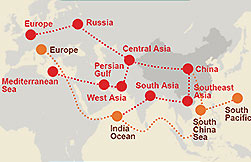
Guangdong University of Foreign Studies plans to increase the number of foreign languages it teaches to about 25 in the coming five years, from the current 20, to serve demand arising from the country's Belt and Road Initiative.
New languages to be added may include Greek, Serbian, Swedish and Turkish, said President Zhong Weihe.
"We plan to introduce languages of strategic importance and demand in the country, with a focus on those spoken in the countries along the Belt and Road," Zhong said.
More than 50 major languages are spoken in the countries along the proposed Silk Road Economic Belt and the 21st Century Maritime Silk Road, which China seeks to develop.
"I think languages are one of the basic elements in building the Belt and Road," Zhong said, adding that some language programs are necessary even though the cost of running them is exceptionally high, given limited resources and small classes.
The university runs an undergraduate program recognized by the Ministry of Education for languages that are less commonly taught. The program has expanded to include 13 languages.
Major languages used in Southeast Asian countries have been added to the curriculum at the university.
Malaysian and Urdu programs will start enrolling students before September of this year.
A lack of qualified teachers stands as a challenge in initiating new language programs, Zhong said. To facilitate new programs, the university will step up its efforts to hire foreign teachers.
The administration also plans to enhance the university's role as a think tank by expanding country-specific research, especially on countries and regions along the Belt and Road, and by introducing more postgraduate programs in those fields, Zhong said.
The university launched its Collaborative Innovation Center for the 21st Century Maritime Silk Road Studies last month in cooperation with related arms of the Chinese Academy of Social Sciences, the Ministry of Commerce, the Chinese Academy of Sciences and a number of universities.
It also plans to promote exchanges with overseas universities, research institutes and think tanks. Cooperative ties already were established with 268 universities and research institutes in 38 countries and regions as of October.
Southeast Asian language programs in China have received impetus from the strategies of "Go Global" and "One Belt, One Road", as well as from the expanding role of China in international affairs, said Zhong Zhixiang, president of the National Education Association of Less Commonly Taught Languages.
The demand for talented people with Southeast Asian language capability continues to increase, he said at the first national seminar on such language programs held at Guangdong University of Foreign Studies earlier this month.
To students learning languages relevant to Belt and Road countries, Zhong predicted increasingly attractive job prospects.
High school students who score high in the college entrance examination are increasingly enrolled in non-English programs at the university.
Fourth-year student Xu Shan chose the Indonesian program as a niche four years ago and has been recruited by a research institute in Zhuhai, Guangdong province, with what she called "an attractive" salary offer.
She spent her third year at Yogyakarta State University in Indonesia, and her future employer may send her to an overseas post.
liwenfang@chinadaily.com.cn
Copyright 1995 - . All rights reserved. The content (including but not limited to text, photo, multimedia information, etc) published in this site belongs to China Daily Information Co (CDIC). Without written authorization from CDIC, such content shall not be republished or used in any form. Note: Browsers with 1024*768 or higher resolution are suggested for this site.
License for publishing multimedia online 0108263 Registration Number: 130349