Place to Go
Lugou Bridge
(china.org.cn)
Updated: 2009-09-18 17:17
"Over this river there is a very fine stone bridge, so fine indeed, that it has very few equals in the world."
The Diary of Marco Polo
The Marco Polo Bridge is located 15 kilometers southwest of Beijing proper. Known also as the Guangli Bridge, it spans the banks of the Yongding River. According to historical records, the "Lugou River is also called the Heishui (Black Water) River." In the local dialect in ancient times, lu (reed) meant black; thus the Heishui River became known as the Lugou River, and the bridge was accordingly given the same name.
Historical records also inform us that the Lugou River was "violent and flowed extraordinarily rapidly." With the post-1949 construction of the Guanting Reservoir upstream from the bridge, a multitude of trees were planted on the river banks and the formerly disposition was also tamed, no longer presenting he constant danger of floods. The Lugou River was also known as the Wuding (Lacking Stability) River, and despite the fact that Emperor Kangxi had the auspicious name Yongding (Eternal Stability) bestowed upon it, it was only after the founding of the People‘s Republic that eh river truly became "eternally stable." After seven centuries, however, the river water remains as swift as ever. Owing, however, tot eh extraordinarily durable construction of the bridge‘s foundation; the endless battering of the torrential current has left no mark on it.
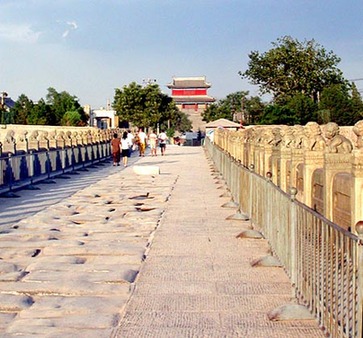
The Lugou Bridge is situated at a strategic point on the one overland route to the capital from the south. Bridge construction was begun in 1189 and completed four years later. The bridge is 235 meters long of white marble. It has 11 arches and as many broad piers. At the extremes of the bridge there are two stone stelae, one recording the history of the renovation work carried out in the reign of Emperor Kangxi (1662-1722), and the other bearing the inscription "The Moon over the Lugou Bridge at Dawn" in the handwriting of Emperor Qianlong.
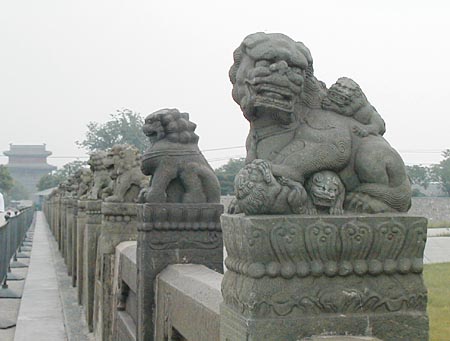
Lining the bridge are two rows of carved white marble balustrades topped by posts carved with figures of lions. The people of Beijing have a saying to the effect that "the lions of the Lugou Bridge are too numerous to count," which is explained by the fact that the lions are carved in a great variety of aspects and distributed unequally among the 280 white marble posts. A pair of vividly carved reclining stone elephants and a number of other animal figures guards each end of the bridge.
On July 7, 1937, the first shot of the War of Resistance Against Japan rang out beside the Lugou Bridge. But now all signs of the war have long since disappeared. As the sun sets, the furnaces of nearby Shijingshna Steel Works cast a red glow across the sky, lighting up the bridge in fiery splendor.
Add: On the Yongding River, Wanping, Fengtai District;