


useful numbers
| name | number |
| inquiry | 96990 |
| pudong airport | |
| luggage storage | t1:68346324 |
| t2:68340076 | |
| lost&found | t1:68346324 |
| t2:68340417 | |
| hongqiao airport | |
| luggage storage | t1:22344553 |
| t2:22381085 | |
| lost&found | t1:22344553 |
| t2:22381086 | |
home >> News
Smart Airports Taking Shape in China
 |
|
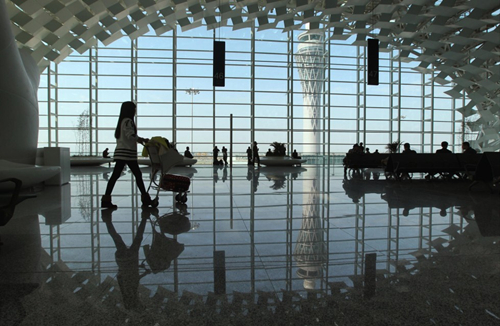
Long departure delays and multiple identity and security checks will soon be a thing of the past at mainland airports. [Photo by K.Y. Cheng/ South China Morning Post] |
Those elements of smart airports in the "internet plus" age may soon be realised on the mainland, which is splashing billions on building airports with the most modern solutions.
"Machine-to-machine, big data, cloud computing and mobility solutions are going to revolutionise the design of future airport infrastructure," said Liu Wujun, the chief engineer at Shanghai Airport Group, which is starting a 20 billion yuan ($3.15 billion) expansion project at Pudong International Airport after its fourth runway entered service earlier this year.
The parent company of Shanghai's two airports signed two strategic partnerships in June, with Alibaba Group Holding and Tencent Holdings, to build smart airports.
Shanghai Airport president Jing Yiming said at the time he wanted to leverage the internet giants' key advantages in big data and virtual payment systems to improve passenger experience, operational efficiency and e-commerce penetration.
Liu said mobile platforms would be the focal point of contact between travellers and smart airports of the future, which would need a lot less manpower and infrastructure.
"The essence of a smart airport is to have zero distance to passengers," said Arkadiusz Czopor, the greater China managing director of Deutsche Telekom, which has advised on Beijing's new 80 billion yuan airport that is being built.
While Europe has been leading the way in smart airport technology, China had a "late-mover's advantage" in planning from scratch and could lead the world in making ideas reality, he said.
"China immediately goes for the most modern solutions... Beijing's new airport is going to be one of the world's most innovative ones," he said.
Construction of the four-runway airport started in December last year and it is expected to enter service in 2019, making Beijing the world's largest aviation hub, able to handle 150 million passengers a year together with the existing airport.
Li Qiang, the chief engineer of Beijing's new airport planning office, said the airport was designed with a system that would keep the average departure delay time under six minutes and taxiing time under 12 minutes by 2025, making it one of the world's best.
Czopor said smart technology could help an airport improve on-time performance by 20 percent by proactively forecasting traffic flow one to two hours in advance based on big data, as was the case at Frankfurt airport, instead of passively reacting to it.
Liu said terminals of the future would be "liberated" from being repeated checkpoints and focus on providing better commercial services and connections with local transport.
"All procedures at an airport come down to identity and security checks," he said. "In the machine-to-machine communication age, passengers should only need to be checked once, instead of up to six times, and then it is just a matter of transferring that information to airlines, airport security, border control, etc."
