Milu deer to be recommended as 2022 Winter Olympic mascot
( Xinhua )
 |
|
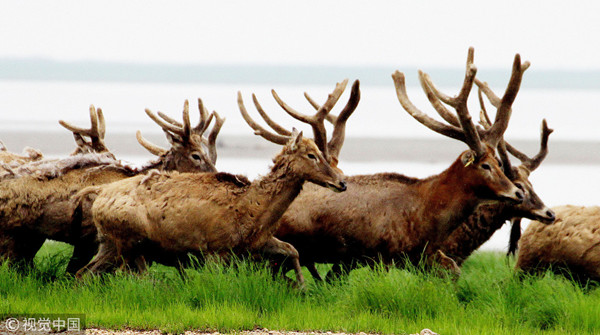
Milu deer [Photo/VCG] |
BEIJING - Beijing's Daxing District and ecological researchers have planned to recommend Milu deer as the mascot for the 2022 Olympic Winter Games, the Beijing Youth Daily reported Tuesday.
Milu, also known as Pere David's deer, is a species endemic to China. It was regularly hunted and almost went extinct by the loss of habitat in the early 20th Century.
In the 1980s, the species were reintroduced to China from Britain, starting the revival of the population in its homeland.
Beijing's Daxing District is home to China's first Milu nature reserve, the Nanhaizi Milu Park. At a press conference Monday, the Daxing district government announced it would work with local research institutes to promote Milu as a mascot candidate for the 2022 Olympic Winter Games.
"Milu deer are good at running on ice. Furthermore, 'deer' has the same pronunciation as the Chinese character 'lu,' which stands for 'prosperity,'" said Qi Jinli, a local official.
In less than four years, Beijing will stage the 2022 Winter Olympics and become the first city ever to host both the Summer and Winter Olympics.
Beijing Winter Olympic organizers have launched a global competition to design the mascots for the Games. Participants could submit their proposals from October 20 to 31, in person or by mail, and the winning designs will be unveiled in the second half of 2019.
Historically, the Olympic mascots have been among the most memorable symbols of the Games. The 2008 Beijing Olympic Games had five mascots which embody four China's popular animals -- the Fish, the Panda, the Tibetan Antelope, the Swallow -- and the Olympic Flame.
In the past three decades, the Beijing Milu Ecological Research Center sent 497 Milu deer to nature reserves around China and boosted the population outside its natural habitat to 1,800.
Bai Jiade, director of the center, said the species has poor genetic diversity, and the leading causes include environmental destruction, overhunting, diseases and a low reproductive rate.
In 2017, the center started a nationwide project monitoring the health and habitat of Milu deer, to help strengthen genetic diversity conservation and reduce the risk of extinction.
This year, a total of 15 Milu deer will be placed in Mihe National Wetland Park in Shandong Province, announced the center Monday.
Chinese people know the species by its informal name, "sibuxiang," which translates to "four unrelated parts," referring to the animal's incongruous features: the neck of a camel, the hooves of a cow, the tail of a donkey, and the antlers of a deer.
 The Area with Six Parks
 Global Top 500