Lifting JV cap a risky move
( China Daily )
 |
|
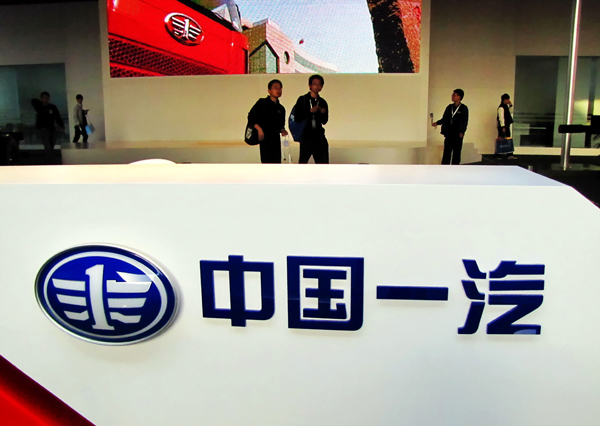
An FAW exhibition area at an auto show in Shanghai. FAW is seeing its joint ventures with international automakers grow fast while its own brands, including FAW Car and FAW Xiali, are losing money. Jing Wei / For China Daily |
Scrapping measure could stall industry momentum and hit companies' profits, warns CAAM boss
A senior executive at China's carmaker association has voiced his opposition to any hasty removal of the cap that limits the stake foreign automakers can hold in joint ventures.
Dong Yang, executive vice-president of the China Association of Automobile Manufacturers, warned that as international automakers are technologically more competitive than their Chinese counterparts, if the 50-50 cap is lifted too rapidly, Chinese brands will lose their last line of defense in the market and China's auto industry will be robbed of its development momentum.
Dong made the remarks at a meeting in Beijing with several major State-owned carmakers on July 22, days after the State Council allowed makers of auto electronic systems and batteries for new-energy vehicles in the country's free trade zones to conduct research and production without partnering with Chinese companies.
Analysts see the move as a potential signal that investment restrictions on foreign car makers could soon be lifted.
The policy, which China promulgated in 1994, requires all foreign automakers and spare-parts producers that want to localize production in China to establish joint ventures, in which their stake must not exceed 50 percent.
Dong is one of the most fervent advocates of the policy, and was once even quoted as saying "whoever supports the cap removal is a traitor to the country".
"If joint ventures end up foreign controled or owned, they might stage unfair competition...and China's drive to upgrade its manufacturing, as well its scientific innovation and even national security will suffer," Dong wrote in his blog on July 26.
Zhang Zhiyong, an independent auto analyst in Beijing, said: "It is merely a matter of time" for China to remove the cap, especially now that China is coming under increasing pressure from foreign countries during trade talks. In addition, there is growing disquiet with the performance of Chinese automakers.
However, despite their lackluster performance, major State-owned carmakers are calling for the government to extend the cap protection.
A representative from FAW said at the meeting that lifting the cap would deal a fatal blow to Chinese automakers, claiming that it would rob them of the chance to acquire core industry technologies.
Headquartered in Changchun, Jilin province, FAW has joint ventures with several international automakers including Volkswagen, Toyota and Mazda.
While those joint ventures are registering steady growth, it is estimated that FAW's two own brands, FAW Car and Tianjin FAW Xiali, will make combined losses of 1.42 billion yuan ($213 million) in the first half of the year due to "less competitive products" and "failure to keep pace with market demands", according to company statements.
Dongfeng Group is also worried that removing the cap will turn the joint ventures into OEMs, thus further squeezing the profits of Chinese automakers. The company said that Chinese brands are currently in a critical phase and require stable policy environments.
The Wuhan-based automaker said that in principle, it is against the removal of the cap. However, it added that if the cap were to be lifted, it should be done gradually.
BAIC Group said that removing the cap would not result in equal benefits for both parties, arguing that it is easier for international automakers to get established in the Chinese market with their funds and technology, while it will remain difficult for Chinese brands to go global.
Private automakers are more open-minded about the cap. Li Shufu, chairman of Zhejiang Geely Holding Group, has long been in favor of removing the protective policy, saying that market competition will force Chinese automakers to improve innovation.
 The Area with Six Parks
 Global Top 500