EV startups face wipeout by new rules
( China Daily )
China's electric-vehicle industry, with 200-plus companies backed by a raft of billionaires, verges on a massive shakeout as the government imposes stricter technology standards on fledgling manufacturers and considers limiting their number to only 10.
Any curbs would be aimed at weeding out the weak, said a senior executive with the State-backed auto manufacturers' association, and they may push as many as 90 percent of EV startups toward extinction, a government-linked newspaper said. So far, only two ventures have obtained approval to build cars, based on a review of National Development and Reform Commission documents. Three others say they plan to apply for permits.
Jack Ma, Terry Gou, Li Ka-shing and Jia Yueting are among the investors who've poured at least $2 billion into building alternative-energy vehicles as China tries to combat the smog choking its cities. Generous subsidies helped to cultivate a gold-rush mentality, prompting concerns the industry is plagued by too many companies lacking the technical know-how to make electric or hybrid cars that measure up to those from Tesla Motors Inc or General Motors Co.
"There are too many entrants in the sector, and some of them are just speculators," said Yin Chengliang, a professor in the institute of automotive engineering at Shanghai Jiao Tong University. "The government has to raise the threshold. It's bad to see irrational investments in projects with low technology levels."
The potential cap on EV startups comes as the world's biggest auto industry grapples with overcapacity and high inventories. Carmakers are seeing pressure on their profit margins with the spread of cheap models, while stringent fuel-economy and emissions targets are set to raise costs.
China surpassed the US last year to become the world's biggest market for new-energy vehicles - comprising electric vehicles, plug-in hybrids and fuel-cell cars. Domestic automakers sold 331,092 units in 2015, according to the China Association of Automobile Manufacturers.
The government's sales target is 3 million units a year by 2025 - a 10-fold increase - and it's offering subsidies that can total 60 percent of an electric-car's sticker price. There currently are about 4,000 new-energy vehicle, or NEV, models in development.
"It's true we're emphasizing support to develop new-energy vehicles, but should we allow everyone to go ahead?" said Dong Yang, executive vice-chairman of the manufacturers' association.
In a draft policy document posted for public feedback this month, the Ministry of Industry and Information Technology listed 17 technologies that companies intending to sell electric cars must possess in order to ensure "healthy" development of the industry. These include a control system that determines the performance and stability of the NEV, an information system that tracks the sources and conditions of key parts, and a process for recycling or reusing batteries.
The Economic Daily, an official newspaper run by the State Council, said 90 percent of the companies currently developing EV platforms still won't meet the standards in two years.
One successful applicant is Beijing Electric Vehicle Co, which is controlled by BAIC Group, the State-owned manufacturer for Hyundai Motor Co and Daimler AG's Mercedes-Benz. It will build a factory in the capital city that's capable of making 70,000 EVs a year.
|
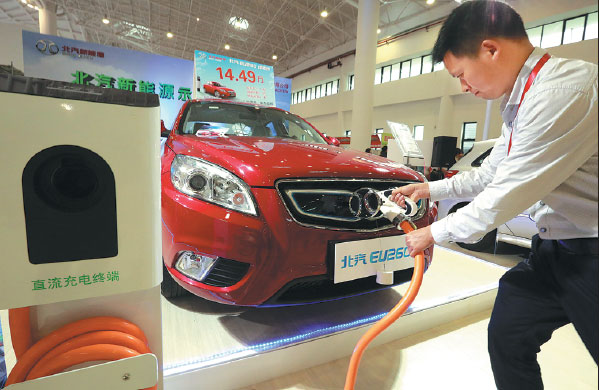
A man charges an electric car at an auto expo in Haikou, capital of Hainan province. Shi Yan / For China Daily |
 The Area with Six Parks
 Global Top 500