Hankoubei's Wuhan model shows how inland regions can open up


Known as the Chicago of China and located alongside the Yangtze River, Wuhan, capital of Central China's Hubei province, has been a business hub throughout the nation's modern history.
In recent years, the city's Hankoubei area has represented the "Wuhan model", showing the world how China's inland regions have found innovative ways to develop their economies.
Since the start of the Age of Exploration in the early 15th century, global trade has been focused on oceans, and the coastal regions in eastern China have emerged rapidly over the past century. However, the vast inland regions of China were left behind because of their geographic disadvantages, and lack of transportation and communications channels and platforms.
This situation has been changing in recent years, as the nation is shifting its attention to its inland regions, to open them up and integrate them into the world economy.
With the proposal of the Belt and Road Initiative, China's international trade is entering an "inland age".
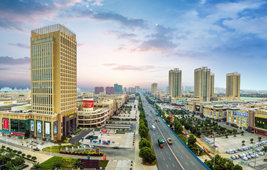
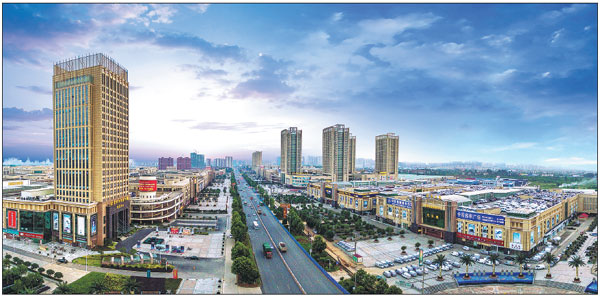
The local government of Wuhan is making efforts to build the Hankoubei area into the nation's biggest domestic trade center.
The area is located between the largest railway station in Asia, the largest airport in Central China and the largest deep-water port in Central China.
In September 2016, the Hankoubei International Commodity Trade Center was listed as a national pilot market for foreign trade by on-the-scene purchasing, the only such market in Central and western China.
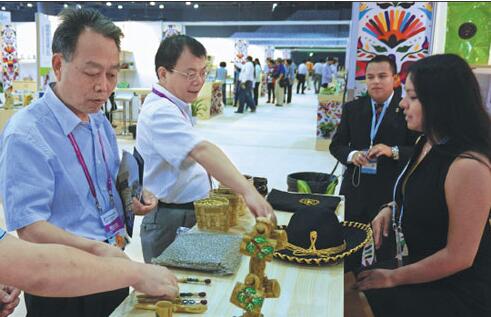
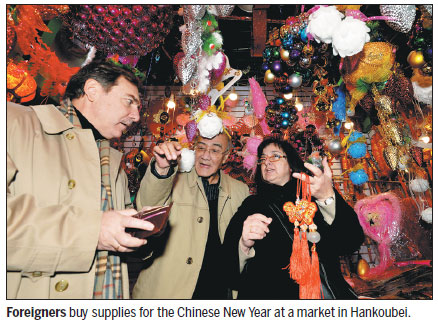
During the first Wuhan International Commodity Fair of Friendship City, taking place from Nov 14-16, more than 100 overseas mayors, officials and entrepreneurs visited Hankoubei, where hundreds of kinds of goods from more than 20 countries and regions around the world were exhibited. More than 100 international buyers were attracted to the event, and about 40 agreements were reached.
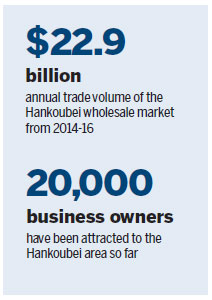
Since its opening-up in 2009, the area has aimed to become a commodity distribution center for not only Chinese inland regions but the outside world. The Hankoubei wholesale market has generated an annual trade volume of more than 150 billion yuan ($22.9 billion) over the last three years.
As e-commerce is currently emerging to become a substantial aspect of trade growth, Hankoubei established a partnership with Chinese e-commerce giant Alibaba in October 2014 to build an industry center in Wuhan. More than 2,000 e-commerce projects have been attracted to the area.
Hankoubei was recognized as a national demonstration base for e-commerce in July 2015 by the Ministry of Commerce.
The local Zall Group, a comprehensive wholesale services provider, has launched online trade and service systems to integrate online and offline businesses, covering wholesale and purchasing management, financing and logistics.
The Wuhan government has unveiled new regulations to support the privately owned economy. It is offering preferential policies related to technology, recruitment and financing, among other aspects, aiming to develop a group of world influential entrepreneurs.
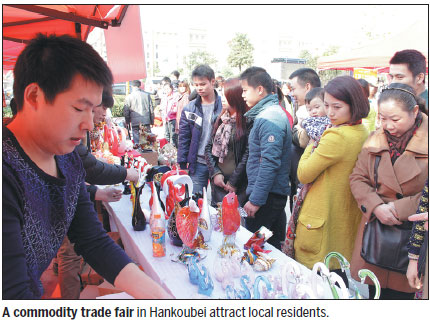
By building the Hankoubei International Commodity Trade Center and holding the annual China Hankoubei Commodity Fair, the area has attracted more than 20,000 business owners, along with nearly 300 logistics companies.
The government has planned an enterprise community covering 3 million square meters of floor space, which aims to become the largest cluster for companies headquarters in Central China.
It has improved the local business climate, integrating innovation resources, industry chains, capital and policies, to attract college graduates to start their own businesses in the area.
zhangzhao@chinadaily.com.cn
|
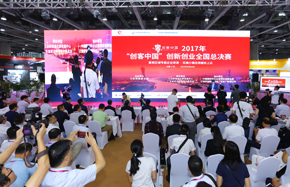
The Hankoubei area aims to become the largest domestic trade center of China.Photos Provided to China Daily |
(China Daily 11/27/2017 page7)