|
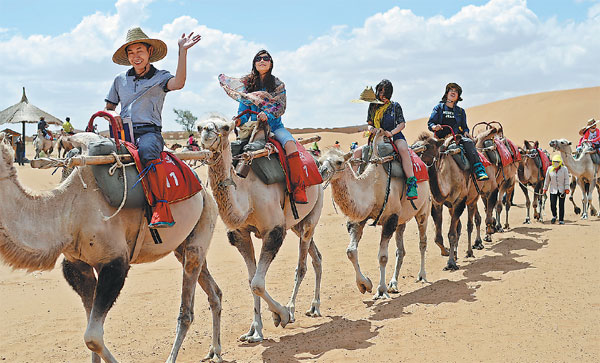
Tourists ride camels in the Sand Lake scenic spot, one of the most unique destinations in Northwest China. Wang Peng / Xinhua |
The Ningxia Hui autonomous region aims to become a model for the concept of "all-region tourism", in which an entire region is developed as a tourist destination.
The region issued an action plan in July for the development of all-region tourism for the 2016 to 2018 period.
It hopes that some areas in Ningxia will develop into national all-region tourism models by the end of 2018, including the cities of Zhongwei and Qingtongxia.
Li Jinzao, head of the China National Tourism Administration, proposed the shift from "scenic spot tourism" to all-region tourism at a national tourism conference held early this year.
Instead of developing an entire region as a tourist destination, traditional scenic site-centered tourism focuses specifically on developing scenic spots.
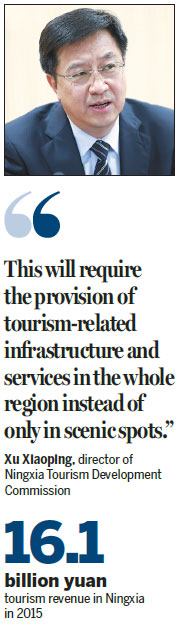
Xu Xiaoping, director of Ningxia Tourism Development Commission, said, "The region's tourism industry has been focusing on the development of tourist attractions, restaurants and hotels for many years and this is 'scenic spot tourism'."
Xu said Ningxia will need to adjust its tourism development strategy in order to promote and develop all-region tourism. "This will require the provision of tourism-related infrastructure and services in the whole region instead of only at scenic spots", he said.
Ningxia also plans to integrate tourism with other industries such as agriculture, finance, culture and sports.
The integration of agriculture with tourism in the region will allow visitors to pick and sample local fruits and vegetables, transforming the countryside from a place inhabited mainly by farmers to one where both tourists and urban dwellers can spend their leisure time.
Administration bureaus responsible for public security, industry, commerce and transportation in Ningxia will work with tourism authorities to manage and monitor the tourism market, Xu said.
The region in Northwest China abounds in both natural and cultural tourism resources. It has mountains, rivers, deserts, forests, gorges and grasslands; its attractions include its Islamic history, the Yellow River, the ancient Silk Road and the Western Xia Dynasty (1038-1227). The region, which has a large Muslim population, is an important window that offers people from Arab countries and Muslim regions the opportunity to discover China.
It aims to strengthen tourism cooperation with those countries and regions and will continue to organize the biennial China-Arab States Tour Operators Conference, Xu said.
International events are necessary for Ningxia to promote its tourism sector and tourist attractions and draw more overseas visitors, he added. An international driving tour organized by the Ningxia government will begin on Sept 24. It will start in Yinchuan, capital of the autonomous region, and pass through more than 20 cities in China, Pakistan, Oman and the United Arab Emirates.
Li Shihong, deputy head of the China National Tourism Administration, said Ningxia's tourism industry has blossomed in recent years, adding that both Ningxia desert and Yellow River tourism have become important national tourism brands.
According to Li, Ningxia helps drive tourism development in the country's western regions and plays a special role in China's tourism industry.
Ningxia's tourism industry took of in 1986 and became a pillar industry of the local economy in 2014. The sector's revenue increased from 6.78 billion yuan ($1.02 billion) in 2010 to 16.13 billion yuan in 2015, with an average yearly growth rate of 18.92 percent. The region received some 10.19 million visitors in 2010 and 18.4 million visitors in 2015, marking a 12.47 percent average annual rate of increase.
It received roughly 8 million domestic and foreign tourists in the first half of this year, a year-on-year increase of 16.7 percent; its tourism revenue from January to June amounted to 7.23 billion yuan, a rise of 19.35 percent compared with the same period in 2015.
It has opened 12 international air routes connecting Yinchuan to cities including Dubai, Singapore and Osaka. In 2013, Yinchuan became the third city in northwestern China to issue visas on arrival, following Xi'an, capital of Shaanxi province, and Urumqi in the Xinjiang Uygur autonomous region.
Ningxia was among 46 Places to Go recommended by the New York Times in 2013.
Its Shahu Lake scenic spot was chosen as one of China's top 10 attractive wetlands at an event organized by China Central Television in the same year.
Despite these achievements, Xu said Ningxia's tourism sector is still plagued by certain weaknesses that require urgent attention, including the lack of both an internationally recognized tourist destination and a world-class travel agency, according to Xu.
Xu added that the region also needs professionals specializing in evaluation for its tourism resources, travel planning and development, and experienced travel guides.
According to a document released by the region's government in January, the area aims to develop 10 leading tourist destinations, support several tourism stores, agencies and restaurants, and train more than 10,000 employees in the tourism sector over the course of the next three years.
songmengxing@chinadaily.com.cn
Wine industry
Wine industry in Ningxia is not only known as a local economic contributor, but also is becoming a key to promote the construction of the autonomous region's all-region tourism.
The wine grapes are mainly planted in the foothills of the Helan Mountains, which is part of the world's grape planting golden belt and also one of the most famous tourist attractions in Ningxia.
In 2012, Ningxia became the first autonomous region in China to be accepted as an official observer at the International Organization of Vine and Wine. It now has 38,000 hectares of vineyards, with combined annual output of 200,000 metric tons, and 98 wineries.
To better develop the all-region tourism, Ningxia has in recent years fought for the right to host different kinds of domestic and international events, in a bid to provide visitors with diverse tourism projects at all seasons.
The autonomous region, for example, held its first automobile and motorcycle self-drive festival in Yinchuan on Aug 6. More than 2,000 self-drive fans from across the world gathered in the city for the event, during which participants could drive from Yinchuan along the Silk Road routes to foreign countries.
The event also attracted some 600,000 visitors. They could also enjoy the unique natural landscape in Ningxia, such as the Yellow River, prairies, deserts, wetlands, cliff paintings and karst landforms.
(China Daily 09/08/2016 page19)


Copyright 1995 - . All rights reserved. The content (including but not limited to text, photo, multimedia information, etc) published in this site belongs to China Daily Information Co (CDIC). Without written authorization from CDIC, such content shall not be republished or used in any form. Note: Browsers with 1024*768 or higher resolution are suggested for this site.
License for publishing multimedia online 0108263 Registration Number: 130349