 |
|
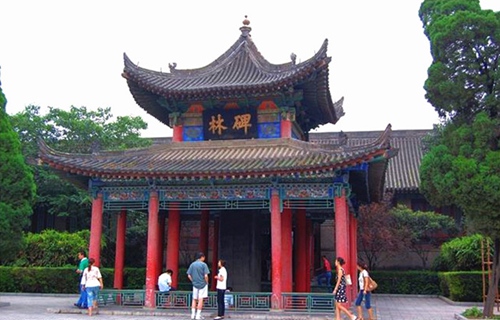
A sign on a pavilion bears the Chinese characters "bei lin", meaning "stele forest". [Photo by Liu Jiaxin] |
The Forest of Stone Steles Museum is situated on Sanxue Street, near the south gate of the Xian City Wall. It was initially established in 1087 when precious stone steles were moved there for safe keeping. Among the initial steles moved include the Classic on Filial Piety written by Emperor Xuanzong in 745 AD and the Kaicheng Stone Steles carved in 837AD.
With an area of 31,000 square meters, the Forest of Stone Steles was Shaanxi’s principal museum since 1944. Due to the large number of stone steles being collected, it became a dedicated steles museum in 1992.
This treasure house holds a large collection of the earliest stone steles of different periods, from the Han Dynasty (BC 206 - 220 AD) to the Qing Dynasty (1644-1911). Divided into seven exhibition halls, the museum mainly displays calligraphies, painting and historical records.
Exhibition halls
Room one in the museum mainly displays the ‘Kaicheng Stone Classics', including twelve lections caved on 114 steles. The lections include the ‘Book of Changes', the ‘Book of History', the ‘Book of Songs', the ‘Analects of Confucius' among others. These were must-read books for intellectuals of the feudal society. At that time, printing technology was primitive, so in order to preserve lections, rulers ordered them to be engraved on the stone steles.
Stone tablets written by calligraphers during the Tang Dynasty (618-907) are exhibited in the room two of the museum. Masterpieces of famous calligraphers such as Ouyang Xun, Yan Zhenqing, Wang Xizhi and Liu Gongquan are displayed there. The Nestorian Tablet is the most useful material for experts to study the cultural exchanges between the Tang Dynasty and the other states.
Room three houses calligraphy collections of great importance to historians. As a traditional art, calligraphy occupies the same position of importance as paintings in the history of Chinese art. In China, the scripts are classified into five categories: seal script, official script, regular script, running-hand and cursive-hand. Many of the tablets display the evolution of Chinese characters.
Painting stones displayed in room four include the portraits of Confucius and Bodhidarma.
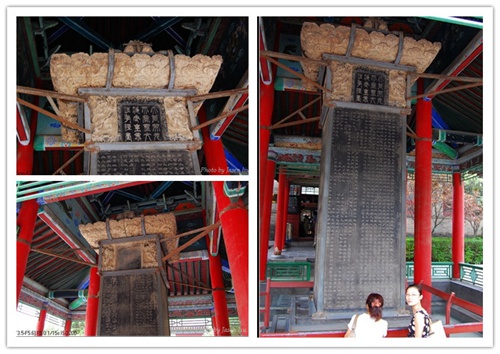 |
| Ancient steles in the Stele Forest. [Photo by Liu Jiaxin] |
Edited by Jacob Hooson


Copyright 1995 - . All rights reserved. The content (including but not limited to text, photo, multimedia information, etc) published in this site belongs to China Daily Information Co (CDIC). Without written authorization from CDIC, such content shall not be republished or used in any form. Note: Browsers with 1024*768 or higher resolution are suggested for this site.
License for publishing multimedia online 0108263 Registration Number: 130349