|
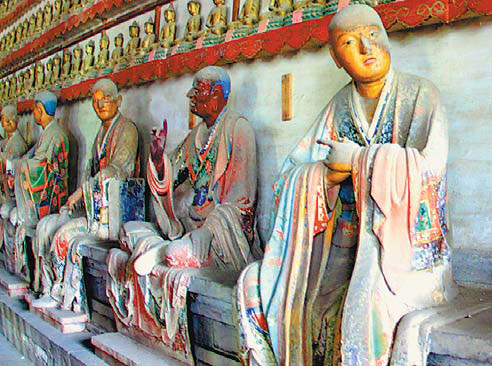
The statues at Lingyan Temple, built during the Song Dynasty (960-1279), are representative of the Buddhist art form at its highest artistic level.? Ju Chuanjiang / China Daily |
It is said Emperor Shun, who lived before 2000 BC, farmed at the foot of Lishan Mountain, which is now Qianfo Mountain in Jinan.
Evidence shows there are human traces in Jinan from the early Neolithic period of 8,000 years ago. Relics of the Dawenkou Culture (4100-2600 BC) have also been found in Jinan's suburbs.
In 1928, the relics of the Longshan Culture were discovered in the town of Longshan in Jinan. It was a late Neolithic culture in China centered on the central and lower reaches of the Yellow River, dating between 3000 BC and 2000 BC.
A large number of pieces pottery, stone and bone ware were found in Longshan. Black pottery pieces as thin as an eggshell represent the high level of craftsmanship in ancient China.
Longshan has been verified as a major national-level base for relic protection and a museum has been built on the site to give visitors a comprehensive understanding of the ancient culture.
The city was given the name of Jinan during the Han Dynasty (206 BC-AD 220). It was a major base for iron production and salt trading.
During the Ming Dynasty (1368-1644), Jinan was the political center for the region known today as Shandong province and its role as the region's political center continues.
The long history has left rich legacies, including a long wall constructed by the Qi State more than 2,500 years ago, the Guo family stone shrine built during the Eastern Han Dynasty (AD 25-220), the Four Gates Pagoda built during the Sui Dynasty (AD 581-618) and the Lingyan Monastery built during the Eastern Jin Dynasty (AD 317-420).
The Lingyan Monastery contains 40 clay statues with bright colors that were made during the Song (960-1279) and Ming Dynasties.
Jinan was also home to many historical figures, including Bianque in the Spring and Autumn Period (770-476 BC), who was the founder of traditional Chinese medicine.
Jinan was also dubbed a "City of Poetry" as it has nurtured many great poets since the Tang Dynasty (618-907).
The southern area of Jinan is dotted with many temples. The Four Gates Pagoda of the Shentong Temple shows a high level of Buddhist architecture. The pagoda roof is supported by a square stone pillar, with carved Buddhas on every face.
At the village of Xicaishi in Licheng district, a 65-meter-long cliff is dotted with 210 Buddha figures. These figures were made during the Tang Dynasty and took 66 years to complete.
Jinan features many intangible cultural heritage items including leather-silhouette performances, Lu Opera and dough sculptures.
A park showcasing local intangible cultural heritage was opened to the public in May. Containing eight zones, it displays more than 1,000 intangible cultural heritage items.
Jinan is also the birthplace of Shandong cuisine, commonly known in Chinese as Lu cuisine, which is among the top four culinary arts in China.
zhaoruixue@chinadaily.com.cn


Copyright 1995 - . All rights reserved. The content (including but not limited to text, photo, multimedia information, etc) published in this site belongs to China Daily Information Co (CDIC). Without written authorization from CDIC, such content shall not be republished or used in any form. Note: Browsers with 1024*768 or higher resolution are suggested for this site.
License for publishing multimedia online 0108263 Registration Number: 130349