Wang Zhenggong, a governor of Guangxi in the Song Dynasty (960-1279) would not have expected his farewell toast to Guilin's imperial test-takers to become a household saying in Chinese for the next 1,000 years.
"Guilin's scenery is the best in the world," Wang said simply.
The Lijiang River and the unique karst mountain ranges extending along the river from Guilin to Yangshuo county are at the core of the renowned scenery.
|
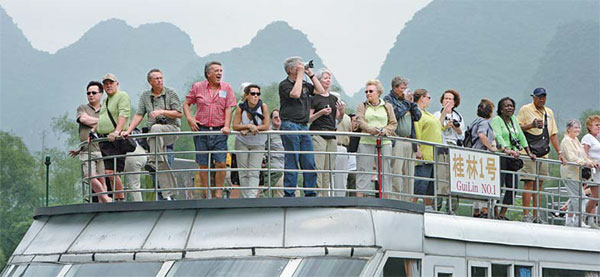
Foreign tourists appreciate the Lijiang River views on a sightseeing boat. |
The legendary scenery often includes bamboo rafts carrying old fishermen in straw hats and hawks highlighted against the green water of the Lijiang River. Bamboo-shaped karst hills are carpeted with thick growth throughout the year.
The karst mountains surrounding the river are not high, but they connect with one another in such an illusionary way that tourists feel they are sailing in a fairyland.
Lijiang was recognized in China's first batch of national key scenic spots in 1982 and one of the 13 rivers under the highest level of national protection measures in the 1990s.
Because of the difficulty in transportation, most of the ancient villages and towns in the mountains along the river, as well as their old lifestyles, are well preserved. More and more urban Chinese and foreigners are moving to the villages to escape the hustle and bustle of city life.
For most of the city's 2,000-year history, Guilin has been a political, cultural, military and economic center in South China. Local painters developed the famous Lijiang painting school by drawing the beauty of the natural landscape.
Lijiang also serves as important waterborne transport line connecting central and south China. Both sides of the Lijiang were home to several important airbases for the Flying Tigers, a US air force helping China resist Japanese invaders during World War II.
Yet there are also environmental concerns. While Guilin authorities shut down factories in the 1970s and 1980s, it is difficult to resist the temptation of revenues from tourism.
The sharp rise in sewage, household garbage and emissions from cars and motorboats now pose the harshest environmental challenge since the industrialization of Guilin in the 1960s and 1970s.
In the 1980s, only five wooden sightseeing boats with a total of 440 seats worked on the Lijiang River. Today more than 300 large boats shuttle along the river, transporting more than 6 million visitors a year.
In contrast with about six million tourists annually and a local population of a million residents 20 years ago, the city now has six million residents and attracts more than 35 million travelers each year. About 2 million Guilin locals make their living from tourism along the Lijiang River.
"A worrisome phenomenon is the invasion of consumerism to local farmers," said a village head in Yangshuo. "It is necessary for the government to raise local people's environmental consciousness. Otherwise, tourism will not be a sustainable cash cow in the long run."
Huo Yan and Li Ziyu contributed to this story.


Copyright 1995 - . All rights reserved. The content (including but not limited to text, photo, multimedia information, etc) published in this site belongs to China Daily Information Co (CDIC). Without written authorization from CDIC, such content shall not be republished or used in any form. Note: Browsers with 1024*768 or higher resolution are suggested for this site.
License for publishing multimedia online 0108263 Registration Number: 130349