|
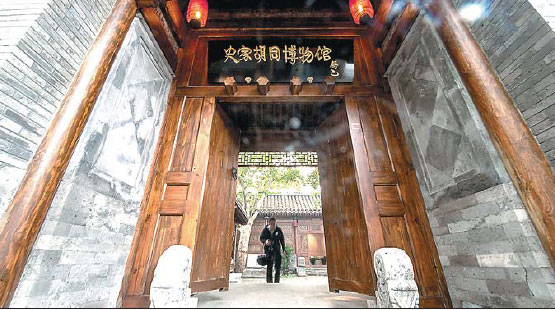
Shijia Hutong Museum is a popular attraction for visitors from home and abroad.?? Provided to China Daily |
Beijing's buildings and the people who have lived in them have drawn attention to the preservation of Shijia hutong.
Residents in the hutong registered a civil society group in August under the Beijing Civil Affairs Bureau, to focus on conserving and restoring the area.
Experts from the Beijing Municipal Institute of City Planning and Design and the Beijing Cultural Heritage Protection Center held a seminar with the residents to discuss the next step in the restoration project on Aug 24.
"We are planning to restore the walls and tiles of courtyards in Shijia hutong to make it look the same as it used to be," said a member of the society.
Now a museum, it shows visitors how hutong buildings have retained their cultural heritage but also transformed over time as the lifestyles of inhabitants have changed.
"The museum is a footnote to the beautiful chapters of the story of Shijia hutong - and Beijing's hutongs in general - and traditional lifestyles," Chaoyangmen sub-district's secretary Chen Dapeng said.
"The best part is that it's embedded in an occupied hutong, so when visitors leave, they feel like they are stepping into another museum," he said.
"Actually every hutong has its own stories and each should have a museum like this," said a nearby resident who gave only his surname, Wei.
Shijia Hutong Museum is housed in the siheyuan, or traditional courtyard, that was once home to celebrated Chinese writer Ling Shuhua.
The building was renovated with authentic bricks and tiles gathered from around Beijing, said Chen, the museum's founder.
Some items in the museum were donated by Suo Ya, who grew up in 49 Shijia hutong in the 1960s. Her grandparents bought the compound in the late Qing Dynasty (1644-1911).
The 57-year-old, who has since moved into an apartment building, said she loaned her student I.D., report cards and schoolbooks from Shijia Hutong Primary School.
"Those objects are my treasures," Suo said. "They record history. While they are precious to me, I have lent them to the museum so more people can see them."
Suo said she would do whatever she could to support the museum and said she was pleased it had opened as it showed people recognized the cultural value of hutongs.
"Many famous figures lived in Shijia, but so did many ordinary people," she said. "They created culture together. Diversity is hutong culture's essence. So the museum should display regular people's belongings, too."
Many of the area's stories - legacies of both regular residents and celebrities - have been lost and even the name's origin is debated.
Some people believe it hails from the prominent Ming Dynasty (1368-1644) Shi family, while others said it derives from Ming chancellor Shi Kefa.
In 1908, the U.S. Congress passed an act creating a scholarship program for Chinese students to study in the United States.
A bilateral agreement created Tsinghua College, and 100 students were sent overseas annually.
In 1909, the imperial Ministry of Foreign Affairs opened an administrative office in Shijia to manage these overseas students.
There were three exams to select the students, who included noted scholar Hu Shi, were held between 1909 and 1911.
The museum reveals this was just one part of Shijia's sometimes-turbulent history.
Ming historian Zhang Jue's Capital City Hutong Collection reveals Beijing's inner city contained more than 900 hutongs during the reign of Emperor Jiajing (1507-66).
When the ethnically Manchurian Qing Dynasty named the city its capital, it didn't alter much of the physical layout but reconceived administrative jurisdictions. It carved the city center into military-defense divisions called the Eight Banners.


Copyright 1995 - . All rights reserved. The content (including but not limited to text, photo, multimedia information, etc) published in this site belongs to China Daily Information Co (CDIC). Without written authorization from CDIC, such content shall not be republished or used in any form. Note: Browsers with 1024*768 or higher resolution are suggested for this site.
License for publishing multimedia online 0108263 Registration Number: 130349