Chengdu Report: Chengdu: Thriving ancient and modern trade hub
Updated: 2014-09-12 10:46
(China Daily)
|
|||||||||||


While the ancient Silk Road is famed throughout the world, another route, the South Silk Road that starts from Chengdu in Sichuan province, remains little known.
A 2,000-kilometer route that began operation hundreds of years earlier than its more famous counterpart, the South Silk Road went through Yunnan province, then Myanmar or Tibet, to reach India and beyond.
An exhibition from Sept 17 to 19 titled "Silk Road and Creative Cities" at UNESCO headquarters in Paris will give an all-round introduction to the ancient route.
"We have made full preparations to inform the world about the South Silk Road and the unique cultural heritage of Chengdu by means of words, pictures, videos, cultural relic replicas and live performances," said a local official.
Sichuan cuisine, traditional Chinese calligraphy and paintings, and other works of cultural creativity with Chengdu characteristics will also be put on display, he said.
The first record of the South Silk Road is from Zhang Qian, a diplomat in the Western Han Dynasty (206 BC-AD 24), who saw bamboo sticks and Shu cloth in Afghanistan, according to Shi Ji, an authoritative history written in the dynasty.
Bamboo sticks and such cloth were mostly produced in Shu, the ancient name for Sichuan province and other southwestern regions. Zhang then found out a path that linked southwestern China to South Asia.
Massive amounts of silk, tea, china and lacquer produced in Chengdu were sold to South and Central Asia over the route.
It was after Zhang discovered the South Silk Road that he opened the North Silk Road, which started from Chang'an (today's Xi'an), the then national capital. The North Silk Road went through what is today Xinjiang Uygur autonomous region, India, Iran and the Middle East to reach the Mediterranean Sea.
Brocade city
Chengdu was famous for its high-quality silk in ancient times. Can Cong, the first king of Shu, was an expert in breeding can, the silkworm that spins silk.
"It is widely acknowledged that Shu brocade is one of the four greatest brocades of China," said Wang Yi, director of Chengdu Museum.
The South Silk Road led to extensive business and cultural exchanges between Chengdu and the countries and regions in the west.
Archaeological discoveries in Chengdu's Qionglai county, an important station along the South Silk Road, unearthed a number of pottery figurines of Hu people - nomads living on the northwestern border of ancient China - and daily utensils from Persia.
A gold mask unearthed in the Jinsha Ruins of Chengdu, which dates back 3,000 years, is believed by some scholars to be the result of absorbed cultural elements from western Asia and the Near East.
The exchanges lead to the open and inclusive character of the city and its rich cultural heritage.
Chengdu is one of China's most famous historical and cultural cities. It was awarded the title of "Gastronomic Capital" by UNESCO in 2010, only the second city in the world and first in Asia to win such an honor.
The rich cultural heritage has been a strong boost for the development of Chengdu's cultural creative industry, which continues to drive the city's economic development. Now the world has taken notice.
Part of the Chengdu Creativity and Design Week to be held in October, an activity inviting people from around the world to draw colored pictures for a giant panda named "51" has caught global attention.
People from at least 19 countries including Germany, Switzerland, Italy and the United States are participating.
Pictures of "51" served as the mascot for a Chinese film convention at the recent 71st Venice International Film Festival.
Following the national strategy to develop western China and build the Silk Road economic belt, local government officials said Chengdu will grasp the opportunity and lead western China's opening up to the outside world, as it has through history.
As a major hub in southwestern China, the city is already home to 255 Fortune Global 500 companies. Eleven countries now have consulates general in Chengdu.
Chengdu Shuangliu International Airport, the fourth-largest in China in passenger traffic, has 74 international flights to a range of cities including London, San Francisco, Amsterdam, Abu Dhabi and Melbourne.
Chengdu is also the first city in western China to offer a 72-hour visa-free policy that allows citizens from 51 countries with a valid visa and air ticket to a third country to stay up to three days.
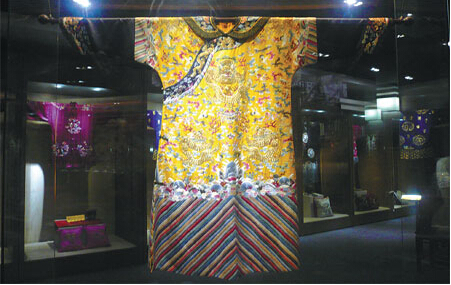 |
| Ancient emperor's clothes made of Shu brocade at the Chengdu Museum. Photos by Wang Jun / for China Daily |
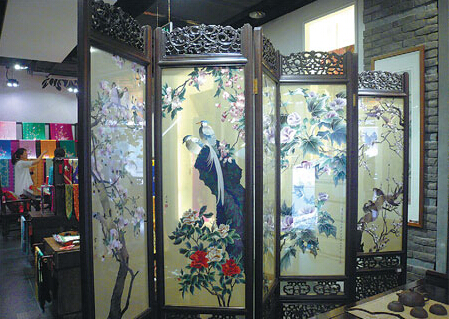 |
| The ancient name for Sichuan, Shu was famed for its silk, which was found as far as 2,000 years ago. |
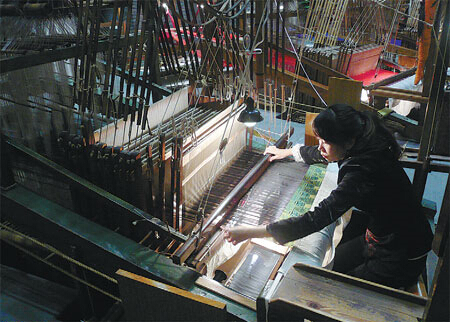 |
| Skilled practitioner makes Shu brocade at the Chengdu Museum. |






Hot Topics
The newly announced overhaul of China's college entrance exam and university enrollment system requires support from all walks of life, said a commentary in the Communist Party of China's flagship newspaper.
Editor's Picks

|
|

|

|

|

|