Qiantang River tide: When the waters engulf the sun and sky
Updated: 2014-08-14 18:28
By Zhang Lifei(China Daily)
|
|||||||||||


Among the many interesting sights in this paradise city, the world-renowned Qiantang River tide is a peculiar attraction, detracting in a way from the image of Hangzhou as tranquil and gentle city.
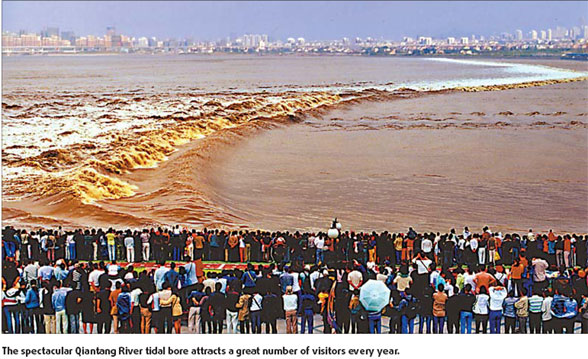
If the West Lake, from which this capital city of East China's Zhejiang Province derives its fame, could be compared to a gentle and graceful young maiden, then the Qiantang tide may be seen as a fearless, all-conquering hero who allows nothing to stand in his way.
The Qiantang River tidal bore, which rises to a height of as much as 3.5m, is a spectacular natural wonder that is probably without parallel in the world.
Smaller tidal bores also occur on England's Severn River, the Seine in France, the Amazon in South America and other river mouths, but none of them can rival Qiantang's in magnitude.
A tidal bore is a phenomenon in which the leading edge of the incoming tide forms a wave (or waves) of water that travels up a river or narrow bay against the direction of the current.
The trumpet-shaped mouth of the Qiantang River, combined with the gravitation of the celestial bodies and the centrifugal force produced by the rotation of the earth help generate the extraordinary tidal waves it is famous for, say experts.
While the Hangzhou Bay at the mouth of the Qiantang is about 100 km wide, the river narrows to a mere 2-3 km at one point -- its Yanguan township section. As the tidal waters are blocked by the narrow river passage, pressure builds up from behind until a tidal bore is formed, creating a high water wall.
In addition, the presence of a submerged sandbar at the mouth of the river acts like a springboard for the tide, sending the crest of the bore higher into the air.
Historical record
The Qiantang tide has been well documented since ancient times.
As early as the fourth century BC, famous philosopher Zhuang Zi once described the huge tide as follows: "The waters in the Qiantang River will roll on, raising waves as high as mountains and towers, creating a thunderous roar and gathering up a force that threatens to engulf the sun and the sky."
The observation of Su Dongpo, a famous Northern Song Dynasty (960-1127) poet, ran thus:
"What on earth can hope to create a spectacular sight,
Like the tides on the eighteenth of August at night."
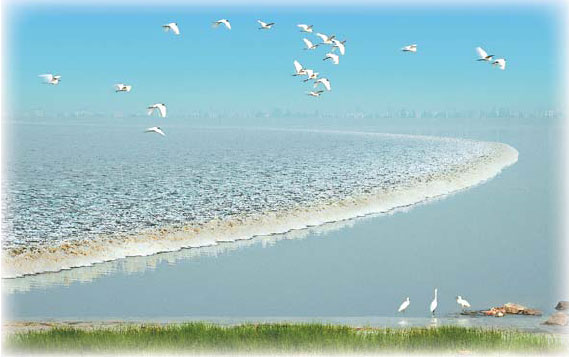
Tide watching on the Qiantang has been a popular activity for centuries, dating back to the Han Dynasty (206BC-AD220). By the time of the Southern Song Dynasty (1127-1279), it had become a well-established event on the social calendar for both ordinary people and the royal court.
The Southern Song government once made a rule to parade its naval forces in the Qiantang River on the 18th day of the eighth lunar month, an event that later developed into the Tide Watching Festival.
Miles of tents and viewing platforms are erected along the banks of the river for the weeklong event, which takes place during the Mid Autumn Festival.
During the festival, brave and expert swimmers line up to test their valor against the might of the tide each year.
There are historical records of men who would attempt to ride the waves of the tide on specially constructed boards. Known in Chinese as "nong chao er" or tide player, they are regarded as the first generation of Chinese surfers. It is a tribute to their daring and skill that the word "nong chao er" has now come to mean people who are brave and courageous in the face of the adversity.
Tide watching
The Qiantang River tide occurs between the 1st and 5th, and the 16th and 20th of each lunar month, while the most breathtaking one occurs on the 18th day of the eighth lunar month.
When thrill-seekers gather on the stone-paved seawall on the day of the tidal bore, they will initially see a tranquil scene with the river placidly flowing eastward with some seagulls soaring gracefully in the distance.
By 1:00 pm, a thin silver band will, all of a sudden, appear on the river in the far distance, very faint, if visible at all, along with a succession of murmuring sounds.
The thin silver band will then become wider and wider and rise higher and higher, looking as though a myriad of silvery white fish were flopping about in ceaseless tumbles or like a huge flock of white swan flapping their wings in upward flight and then moving in and swooping down.
Meanwhile, the slight murmurs will have intensified, sounding now like roaring thunder that sets the earth vibrating.
Then the bore will come still nearer, with a crest that looks like a 3 or 4m-high wall spouting pearls and jade beads every which way, until it comes crashing down Just when you have managed to regain your senses and summoned up enough courage for a closer look, it will already have gone past you, at a rate of 10m per second. What is left before you is the sight of the swollen river stretching for miles without end.
Present situation
Qiantang tidal bore watching is as much popular now as it was 2,000 years ago.
This year, the Qiantang River Tide Watching Festival is to be held from 27 to 29 September.
The vantage point for watching the tide has changed over the centuries due to gradual changes in the river's course as well as in the intensity of the tide.
In the Song Dynasty (960-1279), the best site to watch the tide bore was the 5-km stretch of riverbank that now lies between Miaozitou and the Six Harmonies Pagoda.
With the passage of time and the changes it brings, the best spot to get a view of the tidal bore has shifted now to a section of the seawall at Yanguan township in Haining County, where a number of ancient architectural structures still stand.
Given the Qiantang River's fluctuating water volume and the reclamation of a considerable amount of riverbed near its mouth, a section of the riverbank in Xiaoshan district has also become a favorite tidal bore-watching site.
The tide viewing sites in the Hangzhou city area include Qiantang River Bridge and along Zhijiang Road below the Six Harmonies Pagoda. However, the best places to view the tide are in Xiaoshan district and Yanguan township in Haining county, which have specially designated viewing platforms and are both located less than 50 km from Hangzhou.








Hot Topics
Wei Guirong drives his granddaughters from kindergarten on his home-made three-wheeled vehicle in Luorong county, Liuzhou city of Guangxi Zhuang autonomous region, on May 19.
Editor's Picks

|

|

|

|

|

|