Chengdu exchange
Updated: 2014-05-20 07:03
By Huang Zhiling (China Daily)
|
|||||||||||


The US consul general in Sichuan province is deeply in love with Chinese culture, and wants to encourage more Americans to study in the west of China. Huang Zhiling reports in Chengdu.
People meeting Peter Haymond for the first time are often impressed by his Chinese name, Mengde, a moniker that hints at his deep understanding of Chinese culture.
Mengde was another name of Cao Cao (AD 155-220), a hero from the Three Kingdoms period (AD 220-280) and a historical figure well-known to every Chinese.
Haymond first read the English version of the Romance of the Three Kingdoms, a classic Chinese novel from the period, while he was studying Chinese in the United States in 2002.
He loved the novel so much that, the first time he visited Chengdu in 2004, he left the airport and went directly to the Temple of Marquis Wu. The temple is dedicated to Zhuge Liang, prime minister of the Shu Kingdom, and the personification of wisdom in China.
In September 2011, Haymond started working as the US consul general in Chengdu, Sichuan province, a role he holds to this day.
To Haymond, exchanges between China and the US should be not only on a governmental level but also between people of the two nations.
He hopes more people from the US will choose to study in western China and more people in western China will travel to the US for education.
In the past year, the US consulate general in Chengdu has issued nearly 83,000 non-immigrant visas, an increase of around 70 percent from three years ago.
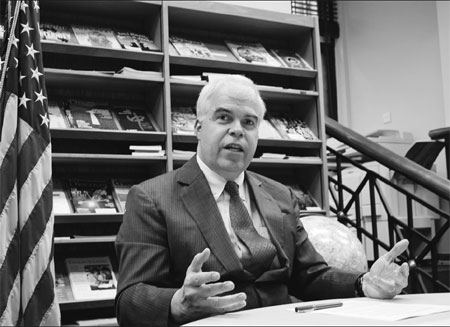
"We have just completed a major renovation at the consulate that more than doubles the number of interview windows in our visa section. With the new workspace and with new visa officer positions at the consulate, we are prepared to issue up to 200,000 visas annually in Chengdu in the future," says Haymond in the newly-renovated library in the consulate opposite its visa section.
Haymond's consulate issues visas primarily to applicants in Sichuan, Yunnan and Guizhou provinces, Chongqing municipality and the Tibet autonomous region.
The number of Americans studying in western China has increased significantly since 2011.
"Aside from full-time American students, there is also a steady stream of young Americans coming to western China to teach English while also studying Chinese. I am not surprised that many of the junior US diplomats now coming to China previously studied or taught in China before they joined the Department of State and began their diplomatic careers," Haymond says.
Haymond enjoys applying lessons from Chinese history and literature to his experiences. He has a particular fondness for a well-known poem by Wang Wei from the Tang Dynasty (AD 618-907), which depicts somebody seeing off a friend on his way to a border area in northwestern China.
Two lines from the poem read: "Friend, I want to persuade you to empty one more cup of liquor before you leave; west of Yangguan Pass you will have no old friends."
"I see this poem as being very applicable to the life of a diplomat, who must leave home and familiar surroundings to go and live with people of different language and culture. But I have found that a diplomat's life is a life of meeting new people, and a life of being enriched by new friends from around the world. So, by contrast to Wang Wei's famous line, I have found diplomatic life to be a "west of Yangguan Pass you will have new friends" experience," says Haymond who became a diplomat in 1991.
Haymond has visited the Jianchuan Museum Cluster in Dayi county, Sichuan, several times. The Flying Tigers Museum is of particular interest to him.
"Any two countries, and particularly two countries with very different histories, different cultural traditions, and different forms of government, are likely to have areas of disagreement. I believe, however, that China and America have many more areas of agreement and common interest," he says.
"The US Environmental Protection Agency visits China regularly to meet with its Chinese counterpart, and vice versa. The US has some experience in gradually reducing air pollution in major cities during the late 20th century, usually by enacting and enforcing more strict controls on what pollutants can be emitted by factories and automobiles.
"Hopefully China can learn from the successes and mistakes of other countries which have gradually improved their air quality, for the benefit of the Chinese people," he says.
Contact the writer at huangzhiling@chinadaily.com.cn
|
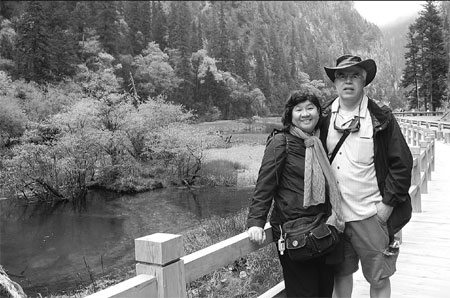
Peter Haymond, consul general of the US consulate general in Chengdu, and his Thai wife Dusadee Haymond in Jiuzhaigou, Sichuan province. Provided to China Daily |
|
Peter Haymond, consul general of the US, at the consulate's library in Chengdu. Huang Zhiling / China Daily |



Hot Topics
Wei Guirong drives his granddaughters from kindergarten on his home-made three-wheeled vehicle in Luorong county, Liuzhou city of Guangxi Zhuang autonomous region, on May 19.
Editor's Picks
|
|
|
|

|
|