Introduction to Mongolia
Updated: 2013-07-11 16:06
|
|||||||||||


Mongolia is a landlocked country located in the east of Central Asia. It borders Russia to the north and China to the south, east and west. Its capital, Ulaanbaatar, is administrated separately as a capital city (municipality) with provincial status. Mongolia is divided into 21 provinces (aimags): Arkhangai, Bayan-?lgii, Bayankhongor, Bulgan, Darkhan-Uul, Dornod, Dornogovi, Dundgovi, Govi-Altai, Govisümber, Khentii, Khovd, Kh?vsg?l, ?mn?govi, Orkhon, ?v?rkhangai, Selenge, Sükhbaatar, T?v, Uvs and Zavkhan.
Capital
Ulaanbaatar has a population of 1.05 million.
National Flag
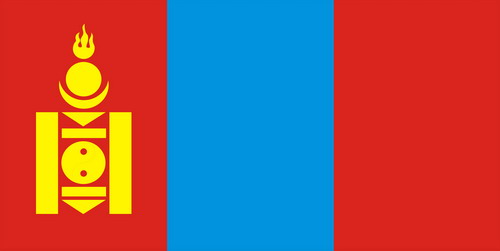
The flag of Mongolia features three stripes - red, blue and red - with the national emblem, the soyombo, in yellow in one of the red stripes. Red represents joy and victory, blue symbolizes loyalty to the motherland, and yellow represents national independence and liberation.
Demographics
Mongolia's total population is 2.8 million. Its population density (people per sq.km) is 1.77. The Khalkha make up 80 percent of the ethnic Mongol population and the remaining 20% include Kazakhs, Dorbod and Buryats. The established religion of Mongolia is Tibetan Buddhism, and some Mongolians practice shamanism and Islam.
Geography
With an area of 1.5665 million square kilometers, Mongolia is the world's 19th-largest country. The geography of Mongolia is varied, with the Gobi Desert to the south and cold and mountainous regions to the north and west. The Selenga and Orkhon are the most important rivers. Mongolia contains over 3,000 lakes, totaling 15,000 square kilometers, and Lake Hovsgol, known as the Dark Blue Pearl of Mongolia, is the largest in freshwater lake in the country, with a total water area of 2,760 square kilometers. Mongolia has an extreme continental climate. Most of the country is hot in the summer and extremely cold in the winter. The temperature in winter can plummet as low as ?40 °C (?40°F), while the highest in summer can reach 35°C (95°F). The average temperature is -2.9 C (26.78°F).
Economy
Economic activity in Mongolia has traditionally been based on herding and the mining industry. It made a transition from a planned economy to a market economy in 1991 and, in 2008, Mongolia's GDP reached $2.85 billion. Mongolia is rich in resources, with 80 kinds of proven mineral resources, including copper, coal, molybdenum, tin, tungsten, gold and petroleum. The Erdenet copper-molybdenum ore is among the world's top ten and the top one in Asia. The area of land covered by forests reaches 8.2 percent of a total area of 18.3 million hectares. Mining, fuel and power companies are the main industrial entrepreneurs, and stock farming is Mongolia's traditional sector. In 2009, the total number of livestock reached 42 million. Mongolia's attractions include Lake Hovsgol, and the official currency is the togrog.