Comments
  Print
Print  Mail
Mail  Large Medium Small
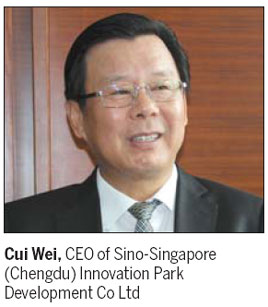
While many of China's top entrepreneurs, managers and executives seek opportunity in top-tier cities in the east and along the coast, Cui Wei is taking the road less traveled by seeking his fortune out west.
The 56-year-old Beijinger, who spent more than 20 years in Shenzhen as an executive in offshore drilling logistics industry, is now living in Chengdu, capital of Sichuan Province.
"I moved to the west not because I read some random book about it or I thought I wanted to be here. My experience over the past two decades allows me to foresee the future of industrial transfer," Cui said, sitting comfortably in his office in the heart of a booming high-tech zone in Chengdu.
"While the fast growth in coastal regions was seen in the first three decades (since the reform and opening-up policy began in late 1980s), the next 30 years will witness industrial growth in the central and western parts of the country," he said.
Cui is now CEO of Sino-Singapore (Chengdu) Innovation Park Development Co Ltd, which is responsible for overall planning, construction and marketing of the Singapore-Sichuan High-Tech Innovation Park, known as SSCIP for short.
The SSCIP is located in the core of Chengdu's Tianfu New Area, a huge swath of land in the city's prosperous southern urban area intended to accelerate its development. The park is designed to be an innovative city within a city that provides a model for coexistence among industry, culture and nature in perfect harmony with one another.
With an area of up to 10.34 square kilometers, the SSCIP is a milestone in the collaboration between Singapore and Chengdu. It also sets the benchmark for clusters of industries with high added value in western China.
The park will focus on developing eight pillar industries - IT, biomedicine, service outsourcing, new digital media, precision engineering, environmental technology, finance and training.
Between 120,000 and 150,000 people are expected to work and reside in the SSCIP.
Multinationals
Though it is still uncertain when the construction work will come to an end, Cui expects firms to be operating in the SSCIP in three years.
His company, a joint venture between Singapore and Chengdu, began reaching out investors in China and other countries last September.
"We hope to have more multinational corporations to make Chengdu more international," Cui said.
"We hope to have Fortune 500 firms or those who are leaders and role models in the eight industries we focus on."
Cui added that they had approached a few of China's State-owned enterprises as well as international corporations, including many multinationals, but he declined to name any of them because negotiations are still at an early stage.
Infrastructure development is ongoing Cui said, and having a clear construction timetable will help to attract investors.
Before the end of next year, the SSCIP aims to complete seven planned trunk roads - four north-south roads and three east-west roads, together with the local government.
They are also in talks with the local officials on a plan to build a convenient public transportation network, including a subway, bus routes and possibly a tram system encircling the park.
But Cui's ambitions extend beyond just building a top-notch high-tech zone with a convenient road and traffic network. What he aims to deliver is "a self-sufficient" community-style neighborhood or township like the kind that can be found in the developed countries.
Community-style
China's fast growth over the past three decades has led to a boom in new towns across various parts of the country.
These new areas often characterized by large construction projects, such as blocks of towers and office buildings, huge shopping malls, vast greenbelts and sizable car parks.
Cui says he does not like the traditional way of development because it does not make efficient use of land nor is it convenient for locals.
In Cui's vision, the SSCIP should have small patches of green land scattered among tower blocks rather than a large one.
"People shouldn't need to drive far for a walk. They could just pull the car in underground parks and walk into the green just outside their homes after dinner," he said, adding the community of Punggol in Singapore is a model to learn from.
Other public amenities, like two small community hospitals rather than big comprehensive hospitals, are also in the plan, he added.
"We feel the Singaporean style of communities fits Chengdu because that country also has high population density," Cui said, noting that residents' convenience should be the first priority when building a community.
In addition, SSCIP will also be an environmentally friendly community with zero emissions because there is no manufacturing in the eight sectors that are covered by the park.
Having lived in Shenzhen for more than two decades, Cui said he experienced the urbanization in China's coastal regions and saw the emergence of environmental issues, which he said was lamentable.
"The coastal regions now need to improve their growth model. The central and western parts should avoid the same mistakes as they prepares for a rapid rise," he said.
zhanghaizhou@chinadaily.com.cn
(China Daily 04/26/2013 page17)

 Ex-inmate runs free school for poor children
 Shanghai's iconic Grand World reopens on 100th anniversary
 Spring scenery across China
 Making a living with fine-feathered friends
 From black-white photos to digital: Wedding images reveal changes in China
 Yoga fans practise yoga on farmland of flowers in C China's Zhangjiajie
 Earth Hour campaign held in China and across the world
 Silver medals honor Belt and Road
 Farmers across China harvest tea leaves before Qingming Festival
 Basketball team established for autistic children
 Death toll climbs to 207 in Colombian landslide
 Serbian PM Vucic declares victory in presidential elections
 Fearless Federer survives Miami scare
 Blades of glory for China's plucky pair


Copyright 1995 - . All rights reserved. The content (including but not limited to text, photo, multimedia information, etc) published in this site belongs to China Daily Information Co (CDIC). Without written authorization from CDIC, such content shall not be republished or used in any form. Note: Browsers with 1024*768 or higher resolution are suggested for this site.
License for publishing multimedia online 0108263 Registration Number: 20100000002731