Print
Print  Mail
Mail  Large Medium Small
分享按鈕
0
Large Medium Small
分享按鈕
0
 |
|
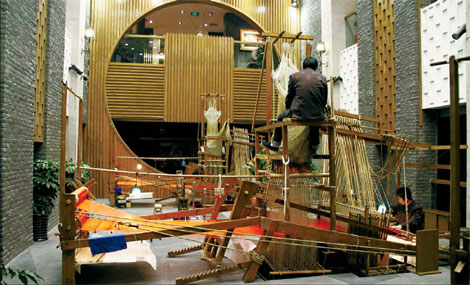
Weavers operate a dahualou loom at the Chengdu Shu Brocade and Embroidery Museum. The ancient loom is made entirely of wood, without a single nail. Photos by Liu Yuanqi / For China Daily |
 |
Exhibits at the Chengdu Shu Brocade and Embroidery Museum show changes in the social fabric throughout history. Huang Zhiling reports.
To visit the Chengdu Shu Brocade and Embroidery Museum is to view the unfolding of the social fabric of what today is Sichuan's provincial capital Chengdu over the millennia, as each display is akin to a stitch in time. And it provides a look into the future of this ancient art form that is named on the UNESCO and national intangible cultural heritage lists and had virtually vanished about a decade ago.
In addition to ancient artifacts, museum guests can also see two weavers operating a hualou loom.
That sight takes 72-year-old visitor Liu Yuhong back. "It reminds me of the good old days, when making things took longer but was more environmentally friendly," Liu says.
Hualou, which literally translates as "big jacquard platform", is a loom invented in the 18th century during the Qing Dynasty (1644-1911). It is made entirely out of wood and doesn't use a single nail. Its parts are easily disassembled and moved.
The brocade museum's original hualou is one of only three in the country. The other two are in the National Museum of China in Beijing and the Sichuan Provincial Museum, says professor Tu Hengxian of the College of Textiles of the Shanghai-based Donghua University (formerly China Textile University).
Tu is a member of an expert panel under the Ministry of Culture that selects items for China's intangible cultural heritage list.
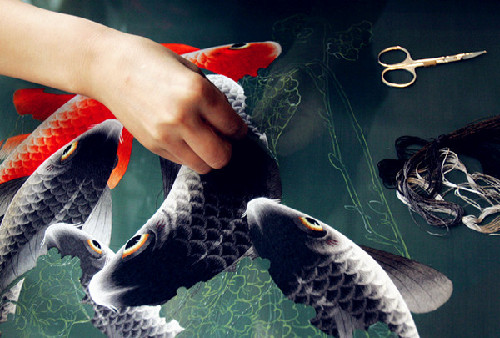
The Chengdu Shu Brocade and Embroidery Museum presents looms, representative works of Shu brocades from the Western Han Dynasty (206 BC-AD 24) to the Qing dynasties and dragon robes worn by emperors of different ages. It also sells modern Shu brocades and embroideries.
The museum reveals the past of the South Silk Road, starting from two millennia ago, not only through its ancient artifacts but also through a fresco that portrays silk productions' 12 processes.
The museum has become a must-see for visitors to the 3,000-year-old city, because it showcases one of the most important local cultural symbols," Sichuan Provincial Tourism Administration chief Hao Kangli says.
China's sericulture began in Sichuan more than 4,000 years ago, when the province was the kingdom of Shu.
Shu is the oldest of the four most famous types of brocade and is the oldest form, from which the others developed.
Shu brocades were exported throughout Asia via the South Silk Road during the Warring States Period (403-221 BC).
The ancient trade route started in Chengdu, passed through Yunnan province and then went on to Myanmar, India, Central Asia and Europe. It started 200 years before the North Silk Road, says Tu, who has studied Shu brocades for 29 years.

In China, most giant pandas live in the mountains of Qinling, Minshan, Qionglai, Daxiangling and Xiaoxiangling.

By the end of 2011, the number of wild giant pandas in the world was about 1,590.
Copyright 1995 - 2010 . All rights reserved. The content (including but not limited to text, photo, multimedia information, etc) published in this site belongs to China Daily Information Co (CDIC). Without written authorization from CDIC, such content shall not be republished or used in any form. Note: Browsers with 1024*768 or higher resolution are suggested for this site.
License for publishing multimedia online 0108263 Registration Number: 20100000002731