Tropical tourism, mysteries and culture
Updated: 2012-03-09 11:04
(China Daily)
|
|||||||||||


|
Huguangyan geopark in Zhanjiang appeals to both tourists and scientists. Photos provided to China Daily |
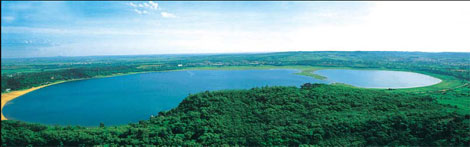
In southwestern Guangdong province with 2,100 kilometers of coastline and 130 islands, the tropical city of Zhanjiang on the Leizhou Peninsula has many attractions to draw tourists.
Its Huguangyan geopark has the world's largest Maar lake in a volcanic valley, a locale of interest to both leisure visitors and scientists. Its water and mud are said to have health benefits.
The park has a number of mysteries to explore - a lake free from fallen leaves despite trees lining its shore or the absence of frogs and snakes despite bountiful fish and shrimp.
Donghai Island, the fifth largest in China, is in the city limits and ringed by 28 km of beaches. One 20,663 meter stretch is recognized by the Guinness Book of World Records as the longest uninterrupted beach in China.
Dragon dancing - men in elaborate costume - is staged on special days in the resort area of the island.
Downtown Zhanjiang has a 2.5 km seaside promenade dotted with palm trees that offers a convenient and relaxing escape from the bustling city.
The city government is making improvements at Techeng Island and Nansan Island, the country's seventh largest, as its develops convention and leisure resorts in western Guangdong, said Mayor Wang Zhongbing.
Already a tourist spot, Techeng Island has more than 66 hectares of natural mangroves that have been noted for more than 500 years.
Xuwen county in the southernmost tip of the city is home to the country's largest area of shallow-sea red coral. The county is accessible by a picturesque freeway through fields of sugar cane, sisal hemp and other tropical crops.
Jizhao Bay in Wuchuan is another stop in Zhanjiang.
In addition to natural wonders, its Leizhou culture - symbolized by carved stone dogs that serve as guardians of the local people - features songs, opera, lion dancing and other traditional entertainment.
Tropical fruit and seafood, not surprisingly, are always there for enjoyment.
The city is also a "vegetable basket" for China in winter and a major flower and seedling tree breeding base.
Zhanjiang received 18.1 million visitors last year, a 28.1 percent increase over the previous year. More than 9 billion yuan was generated by the tourism sector, a 38.2 percent increase over 2010.
Tourism is listed as one of the five pillar industries of Zhanjiang in the city's 12th Five-year Plan (2011-2015). By the end of the period, nearly 43 million visitors are expected annually, producing 25 billion yuan in revenue and contributing 6.5 percent of the city's GDP.
The goal is to build the city into a seaside resort center in South China serving both domestic and international travelers, Wang said.
The city government will boost the spending to promote the Leizhou culture as the fourth major culture in Guangdong - along with Cantonese, Hakka and the Chaoshan cultures.
liwenfang@chinadaily.com.cn
|
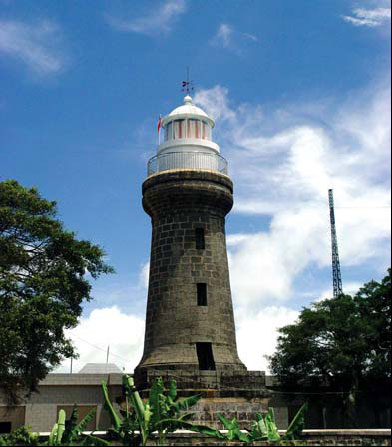
The lighthouse built in 1898 at the city's Naozhou Island is one of the two pearl mirror lighthouses in the world. |
(China Daily 03/09/2012 page13)