
 Comments()
  Print
Print  Mail
Mail  Large Medium Small
|
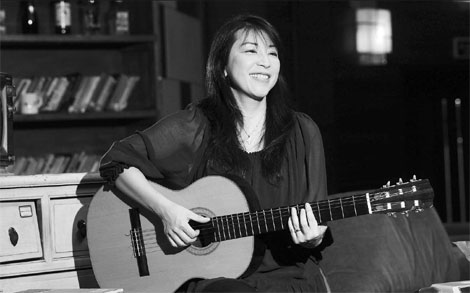
Lisa Ono played in more than 10 cities in China in 2011 and will conclude her tour with a concert in Beijing on Saturday. Zou Hong / China Daily |
Japan's jazz star Lisa Ono says it's her early life experiences in Brazil that have made her such a big hit in China and elsewhere. Chen Nan reports.
Lisa Ono can still recall the warm Brazilian people of Sao Paulo, where she was born and grew up. People sang and danced every day and their generous, enthusiastic personalities deeply impressed her. Though she left the city with her parents and moved to Japan at 10 years old, she says it is that early life that helped mold her happy personality and made her appreciate the beauty of bossa nova, which embodies the Brazilian happy-go-lucky philosophy. "Brazilian people never conceal their emotions. They laugh loudly and cry wildly. Though I moved to Japan, I inherited the easygoing lifestyle of Brazilian people. I love their 'don't worry, be happy' attitude," Ono says.
"I grew up with bossa nova, which is Portuguese for 'new trend'. I cannot remember when I first heard the music. It's always there. The music makes me happy, and maybe that's why I love smiling."
A warm smile is but one aspect of the musically versatile singer who almost single-handedly introduced bossa nova to Asia.
The 50-year-old looks like a typical Japanese woman, feminine and refined, but can still belt out songs. She has toured more than 10 cities in China in 2011 and will conclude the tour with a concert in Beijing on Dec 31.
"I love the beach and beer of Qingdao. People told me that my music goes perfectly with coffee, but I think it goes well with beer too," she says, laughing.
Since she held her first concert in China in 2009, she has become ever more popular. Many cafes play her music, and her fans treat it like a kind of therapy. Listening to her music has become so fashionable that many Chinese singers have released bossa nova-tinged records, including Cheer Chen and Joanna Wong Ruo-lin.
Her father ran a live music club when the family lived in Brazil, so Ono listened to a lot of music growing up.
When the family moved to Japan in 1972, her father opened one of Tokyo's first Brazilian-themed clubs and brought some Brazilian musicians to mingle with local artists. She began singing and playing the guitar at age 15 at her father's club. The impact was instant and made the singer realize that bossa nova was her forte.
"I used to sing samba, but one time I had an opportunity to sing at a hotel lounge, and I was asked to sing a quiet piece," she says. "So I sang bossa nova for the first time, and I thought to myself, 'Finally I've found my music'. The crowd was relaxed, and there was a peaceful atmosphere in the place."

Ono says her success lies in the simple fact that bossa nova is so accessible. The musical genre, often regarded as a fusion of cool jazz and samba, has a unique rhythm structure and simple instrumentation. Piano is occasionally added to the ever-present finger-plucked guitar and airy singing, and it tends to be light on percussion.
"Bossa nova has three important elements, which are a simple melody, a sophisticated harmony, and a happy and light rhythm, based on samba. It has a nice balance of everything," she says.
Ono became a professional bossa nova singer in 1989 after releasing her debut album, Catupiry. Her natural voice, rhythmic guitar playing and her charming smile led to huge success in Japan. Since then, she has released one album a year.
Her second, Nana, picked up Japan's prestigious Grand Prix Gold Disc Award for jazz, a feat she repeated the next year with Menina.
Her popularity in Japan has also led to a number of commercial endorsements, and she has been able to establish her own record label, Nana, which promotes Brazilian music in Japan.
Singing in foreign languages seems easy for the singer, because she grew up in a bilingual environment. She has recorded in Portuguese, Japanese and French. In the summer of 2004, Ono released NAIMA-meu anjo, a collection of African and Arabic songs, done in a bossa nova style. For her album Asia, Ono reinterpreted Asian classics with bossa nova.
For her upcoming Beijing concert, she will sing classic songs by late Taiwan singer Teresa Teng, such as Night Jasmine and When Will You Return.
"My concert in Macao was a surprising experience," she recalls. "I didn't know why I forgot the lyrics on the stage. I was helpless, holding my guitar, when I heard a little girl sing my song off the stage. I quickly remembered the lyrics and finished off the song."
Ono says she has been inspired throughout her career by the great Brazilian Joao Gilberto and has in recent years recorded with a selection of the country's finest talents, including Tom Jobim and Paulo Moura.
She has a new album in the works, dedicated to the victims of the Japan earthquake and tsunami. For the first time, Ono will sing in Japanese.
As a mother of three children, Ono also tries to ensure a work-life balance. "I don't know if they want to be singers in the future. A normal life will be good enough," she says.
Although she has been performing for nearly 30 years, Ono says she still gets the same tingle when she hears bossa nova. "Even if the song is very old, or I have sung it hundreds of times, I always cherish it and keep it fresh," she says. "So each time I can't wait to actually sing it again. The secret to keeping my act fresh is that I just love what I do."
(China Daily 12/27/2011 page20)

 Nanjing Massacre victims remembered in E China
 Isolated school makes do in hills of NW China
 NE China turns pretty in white
 Massacre victims remembered at Nanjing vigil
 Snow to hit Central, East China
 Baby red pandas survive in C China zoo
 Beijing covered in snow
 Supermarket of the future opens in E China
Copyright 1995 - 2010 . All rights reserved. The content (including but not limited to text, photo, multimedia information, etc) published in this site belongs to China Daily Information Co (CDIC). Without written authorization from CDIC, such content shall not be republished or used in any form. Note: Browsers with 1024*768 or higher resolution are suggested for this site.
License for publishing multimedia online 0108263 Registration Number: 20100000002731