Comments()
  Print
Print  Mail
Mail  Large Medium Small
Beijing
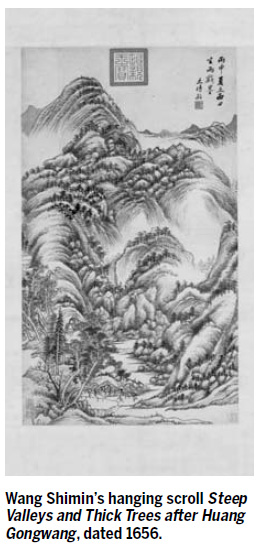
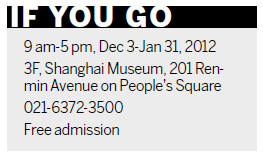
Wang Shimin and Wang Yuanqi brought traditional landscape painting to a final peak in China's art history. The two master painters of the Qing Dynasty (1644-1911) are being featured at a new exhibition in Shanghai Museum that will end Jan 31 next year.
Besides presenting original paintings by Wang Shimin (1592-1680), his grandson Wang Yuanqi (1642-1715) and their later students, the exhibition is also showing some imitation and fine copies, "to help connoisseurs' study and discriminate," according to Shan Guolin, the director of Chinese painting and calligraphy at the Shanghai Museum.
"Wang Shimin and Wang Yuanqi's work marked the ultimate climax of Chinese landscape painting and defined the standard of literati art," Shan says. The Shanghai Museum's collection of their work is "of higher quality than that of the Palace Museum in Beijing."
Wang Shimin's style is marked by soft curves that outline the mountain, and a dense shade of ink to mark its solidness. His strokes are of such skill that trained eyes are able to recognize lots of changes and free use of the unique characteristics of Chinese ink, Shan says.
"Ghost painters can easily copy his composition, but they have difficulty presenting the intricate details and skill of using the ink."
While Wang Shimin was focused on learning from ancient masters, his grandson Wang Yuanqi went a step further to push literati art to an unprecedented height. Shan especially praised a fan painting of Wang Yuanqi in the exhibition.
Altogether 70 sets of original paintings and calligraphy are presented at the museum, alongside with 10 copies.
Wang Shimin enjoyed fame in his late years, and yet he suffered from poor eyesight and household problems and could not satisfy all the demand for his paintings - he used to sign on paintings by his disciples or son.
"Some of the copies were finely done and of quite high artistic value themselves," Shan says. These paintings were first collected by Shanghai Museum as original Wang Shimin works in the early 1950s, and were later detected to be copies thanks to developed technology.
Now "it's hardly possible to find any original Wang Yuanqi work in the auction market. Authentic Wang Shimin paintings are even rarer," Shan says.
In the mid 17th century, China experienced a dynastic change. The Manchurians took over China from the Han emperors of the Ming Dynasty and established the Qing Dynasty. Wang Shimin, coming from a well-known aristocratic family that served the Ming court, refused to be an official in the new regime.
He returned to his hometown Loudong (today's Taicang, Jiangsu province), and devoted himself to painting and calligraphy. He believed artists should learn from old masters and he started imitating works of old masters, especially Huang Gongwang.
Wang Yuanqi, Wang Shimin's grandson, followed family tradition as a painter, and had his own ideas on composition, technique and rhythm.
Later, Wang Yuanqi served as a high-ranking official in the court, and his influence made the Wang style popular not only among painters at court but among officials as well. He had many disciples and admirers in and outside of court.
You may contact the writer at zhangkun@chinadaily.com.cn.
China Daily
(China Daily 12/18/2011 page15)
 Nanjing Massacre victims remembered in E China
 Isolated school makes do in hills of NW China
 NE China turns pretty in white
 Massacre victims remembered at Nanjing vigil
 Snow to hit Central, East China
 Baby red pandas survive in C China zoo
 Beijing covered in snow
 Supermarket of the future opens in E China
Copyright 1995 - 2010 . All rights reserved. The content (including but not limited to text, photo, multimedia information, etc) published in this site belongs to China Daily Information Co (CDIC). Without written authorization from CDIC, such content shall not be republished or used in any form. Note: Browsers with 1024*768 or higher resolution are suggested for this site.
License for publishing multimedia online 0108263 Registration Number: 20100000002731