On the front line of development of Beibu Gulf Zone
Updated: 2011-10-22 08:07
By Liu Xiaoqiong and Huang Feifei (China Daily)
|
|||||||||||


|
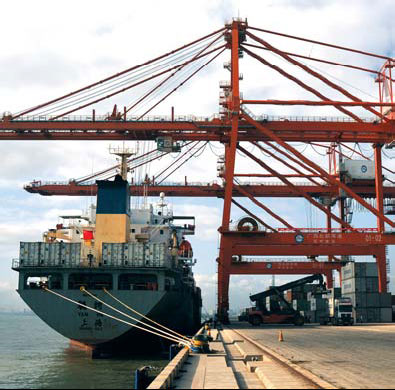
A bustling Qinzhou bonded port. |
|
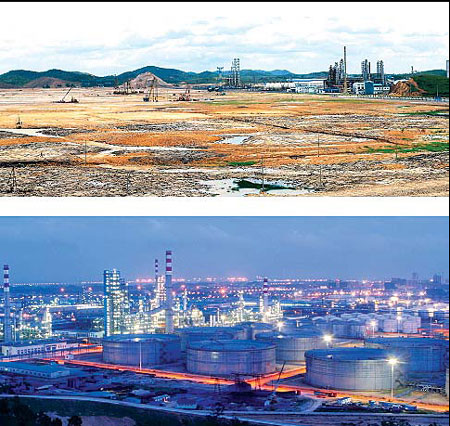
Petroleum refinery project of China Petroleum in its initial stage of construction (above) and night view of the project site after construction work was completed (below). |
Qinzhou is part of the Beibu Gulf Economic Zone, in Guangxi and covers 10,800 square kilometers of land, with a coastline that stretches for 563 kilometers, and a population of 3.88 million.
Qinzhou is a national open port area that is 28.78 kilometers long and contains China's sixth bonded port and its fifth finished automobile import zone. It already has container terminals to handle 100,000 deadweight ton (DWT) ships.
It is also on the front line of development for the Beibu Gulf Economic Zone because it is the closest point for China's central and western parts to the ASEAN region.
Qinzhou clearly represents the views of the State Council on developing Guangxi's economy and certainly has some golden opportunities.
The State Council first approved plans for the Beibu Gulf Economic Zone in January 2008, which made the Beibu Gulf region a part of the nation's development strategy.
Then, in April of the same year, the Commerce Ministry said that Qinzhou was a key place for the processing trade.
The following month, the State Council approved a bonded port there, the only bonded port for a broad area.
In September 2009, the State Council approved a bonded port proposal for finished automobile imports, in Qinzhou.
In March of 2010, the Commerce Ministry announced that Qinzhou was a model of modern logistics in the distribution sector.
In November of that year, the city's harbor Economic Development Zone was made a national economic and technological development zone. The same month, the port got approval to expand even more - to 28.78 km - and add 98 new berths.
Qinzhou is obviously an important city and it has a natural deep-water port. It was, in fact, the port of departure for the Maritime Silk Road in the distant past. In 1919, it was regarded as the second largest port in China by Sun Yat-sen.
Qinzhou has tried to leverage its port status to develop such industries as the petrochemical, automobile, and equipment manufacturing, and industrial clusters in energy, paper-making, metallurgy, foodstuff, edible oil, food processing, and logistics.
Qinzhou has also caught the eye of investors in ASEAN countries, such as Malaysia, Singapore, and Indonesia.
Work on a bigger harbor has begun, for example, 300,000-DWT port facilities, and 10 100,000 DWT berths.
Qinzhou's bonded port area is a center for container routes to Haiphong (Vietnam) and Hong Kong. A connection with Port Klang (Malaysia) will open this year.
By next year, Qinzhou is expected to be a 100-million-ton harbor, and a China-ASEAN free trade harbor. It will be a regional shipping center for international logistics and an export-processing base that is open to the world.
Qinzhou's real development goal is "Three hubs and one new city" for China-ASEAN cooperation: a regional hub of international shipping logistics; an industrial cooperation hub; a market trading hub; and a new harbor city (Qinzhou) that is fit for both merchandising and living.
It wants to use its unique advantages to promote harmonious relations with neighboring countries and to help China-ASEAN cooperation as a part of the China-ASEAN strategic cooperation.
(China Daily 10/22/2011 page6)