Ethnic amalgamation with economic diversification
Updated: 2011-09-20 08:03
By Qiu Bo (China Daily)
|
|||||||||||


|
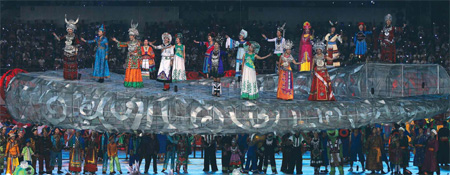
Performance by members of different ethnic groups at the closing ceremony of the 9th National Ethnic Games in Guiyang, Guizhou province. Wang Jing / China Daily |
Go deep enough into the history books looking for China's Guizhou province and you'll discover that this ethnic region has a long, splendid story to tell.
The Chinese classic, the Shiji, or Book of History, written by Sima Qian of the Han Dynasty (206 BC- AD 220), mentions Guizhou's Yelang as an early historical document.
These days, according to Wu Jun, a provincial ethnic affairs official, 39 percent of Guizhou's people are members of ethnic groups and 68 percent of its land is in autonomous prefectures.
"We have 252 autonomous towns - the biggest number of anywhere in China," Wu explained.
The provincial government has declared that its purpose is to protect this national culture and heritage.
Danzhai county, for example, has separate courses in its primary and high schools on their traditions, such as dance and embroidery.
The government stated 10 years ago that the province needs to hold regular cultural and sports events. It has already put on four national cultural performances and seven sports galas and has courses on heritage at 1,000 local schools.
Many ethnic groups hold traditional events, such as the Yi group's Torch Festival, which are enjoyed by many groups, said Liu Gui, a Central University for Nationalities professor.
Liu, who studies folk culture, said it is rare to see the traditions so successfully passed on and shared by other groups, in other parts of the country.
"Guizhou is a microcosm of ethnic group amalgamation," he added.
Improving lives
And, although Guizhou has often been seen as one of China's less developed regions, it has nonetheless not slowed down in its attempts to improve the economy, especially in ethnic areas.
In 2010, its autonomous prefectures had a gross production value of almost 115 billion yuan, or a 51 percent increase over five years previous. Local per capita annual incomes reached 3,258 yuan, or an increase of nearly 50 percent during the same period.
The opening ceremony of the recent 9th National Ethnic Games in Guiyang, Guizhou's capital, surprised the large number of people who are interested in ethnic culture. The magnificent show was carried live by China's Central Television and seen by more than 130 million people and was an example of how the province has developed in recent years.
Li Yuanhao, a Workers Daily reporter, had this to say, "The ceremony really impressed all of us and was simply wonderful."
Another witness, Zeng Peilin, visitor from Jiangxi province, said, "I was overcome with admiration for the performances. I could feel the happiness of people in Guizhou throughout the show."
Yang Jun, deputy head of the provincial tax bureau, told with obvious pride, "The province was founded 60 years ago, and, in all that time, this was the first time for it to independently hold such a large gathering and sports competition."
Liu, the professor, concluded, "It perfectly reflects (the idea) that ethnic groups should not concentrate just on their own traditions, but should develop the region's economy together with other groups with local government assistance."
(China Daily 09/20/2011 page22)